Tens of Thousands Rally for Lula on Copacabana on the Eve of Brazil's Runoff Against Flávio Bolsonaro
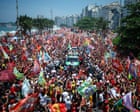
Tens of thousands of supporters of Brazil's leftwing president, Luiz Inácio Lula da Silva, streamed onto Rio's most famous beach on Saturday, the eve of the presidential election runoff, for a giant rally they hope will propel him towards a historic fightback against his far-right rival, Flávio Bolsonaro.
Nearly 159 million Brazilians will vote in Sunday's runoff. In the first round on 4 October, Bolsonaro won 47% to Lula's 45%; the pair are now tied in the polls.
On Saturday, under a fierce sun, red-clad crowds packed the 2.5-mile Copacabana beach. Never since the return of democracy to Brazil in the 1980s has a first-round loser managed to bounce back and win — Lula is attempting exactly that unprecedented comeback.
Josias Silva, a 61-year-old truck driver, voiced confidence that his 80-year-old president would win a fourth non-consecutive term. He carried a homemade sign to the carnival-like procession reading: 'Lula re-elected. Tomorrow will be a new day.'
'The people have woken up,' Silva said of the large pro-Lula street protests that have swept Brazil since the leftist's first-round defeat, many of them led by students.
'Young people know we need this victory because otherwise we will have dictatorship again — and we don't want dictatorship. We don't want hatred. We don't want guns. We want a country of love,' he added, celebrating the large number of people who came to witness one of the final presidential campaign rallies in Lula's storied 50-year political career, and claiming it was the biggest protest in Brazil's history and that Lula would win with more than 60% of the votes.
Polls suggest a far tighter margin, and most analysts see Bolsonaro, whose father Jair Bolsonaro was president from 2019 to 2022, as the slight favourite, having sold himself to voters as someone who will tackle chronic levels of violent crime with an iron fist.
In recent days, however, Lula has appeared to regain the initiative and climb in the polls, amid a succession of scandals involving his rightwing foe. Last week the Brazilian magazine Piauí claimed that at the height of Brazil's 2020 coronavirus outbreak, Flávio Bolsonaro attended a boat party attended by sex workers and vaccine lobbyists hoping to strike a deal with his father's government.
At the Copacabana rally, activists unfurled an enormous yellow and green banner declaring: 'WE ARE GOING TO TURN THIS AROUND!' 'I'm super excited. Lula's going to win,' said Marta Moraes, a 59-year-old restaurateur, as she joined Saturday's demonstration.
Moraes said the election was not about left versus right. 'We've nothing against the right... what we're against is Bolsonarismo,' she said, tears filling her eyes as she recalled how Flávio Bolsonaro's father botched the response to Covid during his chaotic 2019-2022 administration. 'I lost four members of my family because of Bolsonaro's neglect,' Moraes said.
Jair Bolsonaro is serving a 27-year prison sentence for plotting a coup after he lost the 2022 election to Lula. Many Brazilian democrats fear he will be released — and could even return to government — if his son wins. Reports in the Brazilian press suggest several of Bolsonaro's fellow plotters, now in prison or hiding in exile, may be given top military and police jobs in a Bolsonaro administration.
Cammy Marinho, a 49-year-old DJ and activist, said: 'I'm here to prevent democracy becoming extinct — which is what the Bolsonaro family wants.' She said she had spent the past fortnight fighting to persuade people who voted for Bolsonaro, or did not vote in the first round, to back Lula — 'in the bakery, in the supermarket, on the underground — whenever you feel there is an opening to talk to someone.'
Many marchers were part of the so-called 'Lula's Army' — a 10-million-member WhatsApp group created after the first round in the hope of turning the election around. 'Being a soldier in Lula's army means fighting for Brazilian democracy. This isn't a normal election,' said Isabella Gaze, 64, a retired teacher and one of the group's members. Among the faces on the beach was 14-year-old Heitor Lopes da Silva, who had come from Duque de Caxias in his wheelchair with a placard reading: 'Lula, I'm a person with a disability and I'm here to support you.'
Large crowds of Bolsonaro supporters also hit the streets, including in Belo Horizonte, the capital of Minas Gerais state, which has Brazil's second-largest electorate after São Paulo and is a key bellwether — no presidential candidate has ever won the presidency without securing Minas Gerais, where Bolsonaro led by just under 5% in the first round. Sunday's vote will now decide whether Copacabana's sea of people becomes Lula's historic comeback, or whether the Bolsonaro family returns to power.