HPV Vaccine Against Cervical Cancer: Health Minister Says 90 Percent Target Achieved
Health Minister Sardar Md Sakhawat Hossain has said that 10-year-old girls are now being given the human papillomavirus (HPV) vaccine under the Expanded Programme on Immunization (EPI) to prevent cervical cancer. Skilled manpower is being recruited and equipment supplied, including arrangements for HPV DNA testing, at upazila-level hospitals to detect this cancer, he said.
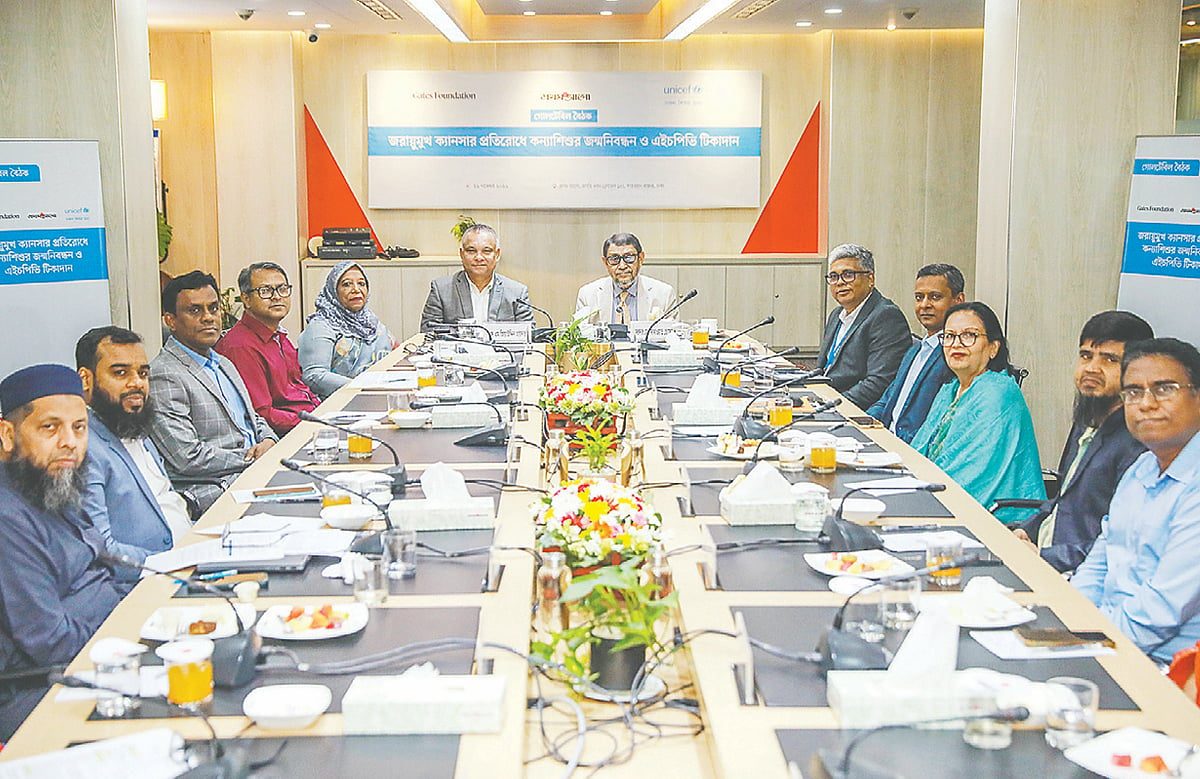
The minister said this at a roundtable titled 'Birth registration and HPV vaccination of girls to prevent cervical cancer'. The roundtable was organised by the United Nations Children's Fund, UNICEF, with support from the Gates Foundation.
At the meeting, the health minister said the government has achieved nearly 90 percent of its target in the HPV vaccination programme, and that this success must be sustained. He said 17 new linear accelerator radiotherapy machines will be installed across the country to increase cancer treatment capacity. He also raised the need to recruit the manpower required to operate these machines and to increase allocation for the health sector.
Taking part in the discussion, the prime minister's special assistant for health, SM Ziauddin Haider, said new initiatives are being taken in the country's primary and secondary healthcare to ensure detection of cervical and breast cancer and treatment at an early stage. Alongside building special cancer detection arrangements at upazila health complexes, cancer treatment capacity will be increased at district and medical college hospitals. The government is investing money to implement this initiative and is also raising funds from development partners.
SM Ziauddin Haider also said a special corner for cancer will be set up at every upazila health complex. He stressed bringing the quality of all vaccines, including the HPV vaccine, under monitoring to check whether it is being maintained.
Presenting the overall vaccine situation at the meeting, UNICEF health manager Riad Mahmud said the HPV vaccine was added to the EPI programme last year. The vaccine is being given to 10-year-old girls in the country. At present, 164 countries administer the HPV vaccine. Sixteen countries have ensured 90 percent coverage, and Bangladesh is one of those 16 countries.
Riad Mahmud said five thousand women die of cervical cancer in the country every year, and nine thousand women are newly affected every year. Yet this cancer is preventable. A single dose of the HPV vaccine is enough to eliminate this cancer. A target has been set to eliminate this cancer by 2030. However, alongside adolescent girls, women must be brought under screening and their treatment ensured.
In three EPI campaigns including HPV and typhoid, vaccination was given after registration through the VaxEPI app. Using birth registration certificate numbers, e-health ID cards have been given to more than twenty million children and adolescents.
Taking part in the discussion, senior scientist of the International Centre for Diarrhoeal Disease Research, Bangladesh (icddr,b), Firdausi Qadri, said that although rumours are spread about various vaccines, rumours about HPV are fewer, because mothers are aware about this vaccine. She stressed ensuring that no girl is left out of this vaccine anywhere, including the hill tracts.
Professor Firoza Begum, president of the Obstetrical and Gynaecological Society of Bangladesh (OGSB), said mothers go to obstetricians and gynaecologists. These specialists will be able to counsel mothers so that they give the HPV vaccine to their adolescent daughters. Many people have a misconception about this vaccine — that it will affect having children in the future. That is not actually correct, and mothers must be made aware of this too.
Md Mehedi Hasan, assistant registrar general for birth and death registration at the Local Government Division, said parents do not want to register their children's births unless compelled. Besides, there is a tendency to show a child's age as lower at the time of birth registration. As a result, it can also affect vaccination. Awareness needs to be raised on this issue.
At the roundtable, adolescent representative Avantika Karmakar said she took the HPV vaccine from school. However, she does not have much idea about what cervical cancer is. Her school teacher told her she would know when she grows up.
Islamic Foundation director Shahana Afroz said trained imams can play a role in raising awareness in various ways in the HPV vaccination programme, including speaking in Friday sermons. She mentioned that before giving this vaccine, the child being vaccinated should also be explained in simple terms what the uterus is and why cancer can occur.
Also taking part in the discussion were Abu Sayeed Mohammad Hasan, SRHS specialist of the United Nations Population Fund (UNFPA); Hasanul Mahmud, deputy director (EPI and surveillance) of the Directorate General of Health Services; Abu Ahammad Al Mamun, director (MIS) of the directorate; and Chiranjit Das, national professional officer (immunization) of the World Health Organization in Bangladesh.