Shoppers Struggle to Buy Fish at Dhaka's Meradia Market as Tengra Is Asked at 750 Taka a Kilo
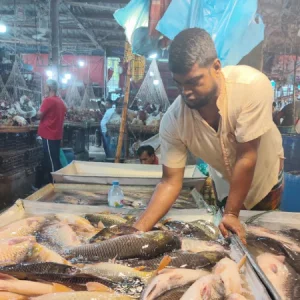
On Monday (26 October) at 7:30 in the morning, Nazia Rahman, a parent, came to shop at Meradia market in Dhaka after dropping her child at school. At the fish market she walked from side to side looking at the fish, but the prices did not match what she could pay.
Nazia Rahman says she is trying to buy small fish, but the prices do not work out. Tengra is being asked at 750 taka a kilo, and the seller says he will give it for 720. Mola is being asked at nearly 500 taka a kilo, and even small puti is priced above 300 taka. In her words, she cannot decide what to buy.
She says that with prices rising this way, they have to think first about what fish they can eat at all. How long can her son and daughter keep eating rui, pangas or tilapia, she asks. In her words, a lower-income family like theirs has to think long and hard before eating a little better; if they feed the children polao and roast one day, they cannot think of having it again for a month.
Nazia Rahman says her family has four members, including a son and a daughter. Her husband works at a private organisation. On his income they cannot properly cover house rent, the children's studies, food and medical care, and they also have to look after relatives at their village home. Altogether, they are struggling to cope. In her words, they can no longer keep up with the rising prices of daily essentials, and when they cannot fulfil their children's wishes, all they can do is cry silently.
Ayesha Begum, who came to the market with Nazia Rahman, says families like theirs are suffering the most. Those whose monthly income is around 40,000 taka are caught in a double bind; they can neither live in a poor place nor live poorly. In her words, they are the ones now living with suppressed tears in Dhaka city. And those who are poor are not well either; it is not as if they are eating well or dressing well twice a day.
Mintu, a fish seller at the market, says there is nothing they can do. He sells fresh rui and katla, which usually come from the northern region. He used to sell this fish at 220 to 250 taka a kilo, and the larger ones at 300 taka, but now prices start at 360 to 380 taka. They have to buy at higher prices, and the cost of bringing fish to Dhaka is now almost double what it was. In his words, they will not sell fish at a loss, nor can they make much profit; even though he sells fish, he too has to eat, so he is a victim like everyone else.
Vegetable prices at the market, however, were unchanged today. Pointed gourd was selling at 60 taka a kilo, potato at 35, bitter gourd at 80 to 100, kakrol (spiny gourd) at 80, dhundal (sponge gourd) at 60, ridge gourd at 70, snake gourd at 50, brinjal at 80 to 130, tomato at 150, beans at 120, okra at 50, cauliflower at 60, radish at 60 and papaya at 30 taka a kilo. Tomato, which sold for 100 to 120 taka a kilo a few days ago, has come down from about 250 taka, and yardlong beans have also fallen from 100 to 120 taka to 60 to 70 taka.
Prices of other daily essentials have risen, though. Flour (maida) has risen from 140 taka for two kilos to 180, sugar is 110 taka, packet atta has risen from 65 to 70 taka and loose atta is selling at 40 to 50 taka a kilo. All kinds of bath soap have risen by 5 to 10 taka, detergent powder (Wheel) has risen from 145 to 155 taka a kilo, and Wheel soap has risen from 30 to 35 taka. Among loose rice, the cheapest, Guti Swarna, is selling at 50 taka a kilo.
The price of eggs has fallen by 10 taka to 140 taka a dozen. But ginger has risen from 160 taka to 180 to 200, garlic from 180 to 200, thick masur lentils are selling at 100 taka and thin masur at 150 to 160 taka a kilo. And polao rice is selling at close to 200 taka a kilo.
Shoppers at the market say that at current prices, simply running their lives has become a burden. Life is even harder for ordinary people, especially auto-rickshaw drivers, rickshaw pullers and labourers. Shoppers say traders are telling them prices will rise further; if they do, people's lives will become even harder. In their words, the government should take proper steps on this.