Prime Minister Tarique Rahman Leaves Dhaka for Four-Day Visit to Japan
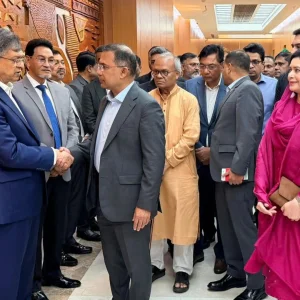
Prime Minister Tarique Rahman has left Dhaka for Japan on a four-day official visit at the invitation of Japanese Prime Minister Sanae Takaichi. The Biman Bangladesh Airlines flight carrying him departed Hazrat Shahjalal International Airport at around 12:15am on Sunday night (October 25).
The prime minister will stay in Japan from October 26 to October 29. His entourage includes his wife Dr Zubaida Rahman and several others. During the visit, he will take part in high-level meetings between the two countries.
Home Minister Salahuddin Ahmad, BNP acting secretary general and the prime minister's political adviser Ruhul Kabir Rizvi, National Parliament Chief Whip Nurul Islam Moni and Dhaka North City Corporation administrator Shafiqul Alam Khan Milton saw the prime minister off at the airport.
Foreign Ministry sources said Tarique Rahman will hold a high-level bilateral meeting with the Japanese prime minister during the visit. He will also meet representatives of major Japanese companies and development agencies and visit various industrial and energy installations. He will present the keynote paper at the 'Japan-Bangladesh Economic Forum'.
The bilateral meeting between Prime Minister Tarique Rahman and Sanae Takaichi will be held at the Japanese prime minister's office on October 27. The Japanese prime minister will host a luncheon in honour of the Bangladeshi prime minister.
Sources said the visit is expected to deepen the existing strategic partnership between the two countries and attract Japanese investment. It is also expected to expand trade and accelerate ongoing development projects.
Discussions will give special importance to the effective implementation of the 'Bangladesh-Japan Economic Partnership Agreement' (EPA) signed in February 2026, increasing access for Bangladeshi products to the Japanese market and strengthening business relations. Renewable energy, agriculture, science and technology, digital transformation, skills development and human resource training will also feature in the talks.
The prime minister will meet Japanese business leaders. His itinerary includes meetings with the chairman of the 'Japan-Bangladesh Parliamentary Friendship League' and the 'Japan-Bangladesh Committee for Commercial and Economic Cooperation'. Meetings are also scheduled with the president of the Japan International Cooperation Agency (JICA), the governor of the Japan Bank for International Cooperation (JBIC), the president of the Japan External Trade Organization (JETRO) and the chairman of the Sasakawa Peace Foundation.
The itinerary includes visits to an LNG terminal and a power plant in Futtsu City of Chiba Prefecture, and to Uniqlo's headquarters and a Toyota factory in Nagoya.
Draft memoranda of understanding (MoUs) and cooperation agreements on agriculture, fisheries, human resource development, skills enhancement, civil aviation, trade, environmental conservation and modernisation of the local government system have been discussed between the two sides. Around eight MoUs are currently under discussion, of which three to four may be signed during this visit. Separate work is also under way on an agreement on education and human resource development, and several MoUs are expected to be signed.
Detailed discussions are also planned on Japanese assistance, aligned with priorities, for setting up factories in Bangladesh, creating employment and developing human resources. There may also be discussions on regional and international peace and stability, a sustainable and peaceful solution to the Rohingya crisis, strengthening cooperation to tackle the energy crisis, and efforts to resolve international conflicts.
Ahead of the visit, an investment package of around US$13.8 billion has been proposed for 12 priority sectors for the 2026–2031 period. Some of the initiatives are linked to the 'Bay of Bengal Industrial Growth Belt (BIG-B)'.
The proposed package includes US$3.45 billion for transport and urban connectivity, US$3.14 billion for integrated industrial, port and commercial hubs including Matarbari, US$1.57 billion for manufacturing, semiconductors and the automobile sector, US$1.26 billion for energy and green transition, and US$940 million for climate-resilient infrastructure. A further US$3.45 billion has been proposed for other sectors including agriculture, pharmaceuticals, information and communication technology, the blue economy, tourism, and small and medium enterprises.