Five Questions Before the Camp Nou Showdown: Raphinha's Form, Mourinho's Return and the Gap in Barcelona's Defence
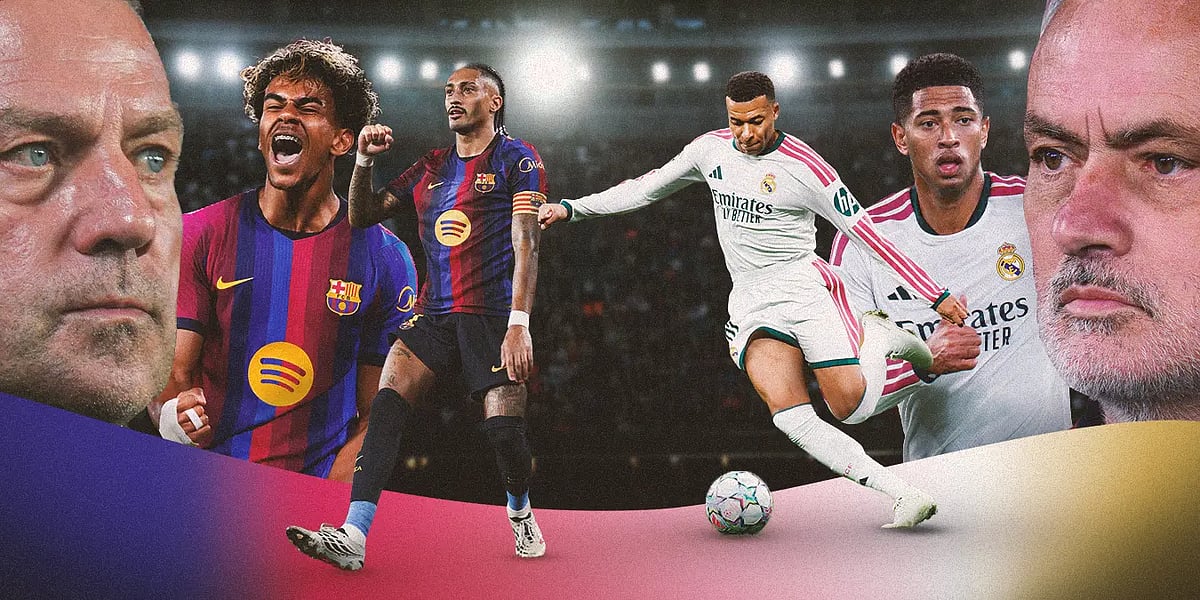
There was a time when El Clasico meant Lionel Messi against Cristiano Ronaldo, with Pep Guardiola and Jose Mourinho fighting the battle of minds. That era is gone. But ahead of tomorrow night's La Liga clash between Barcelona and Real Madrid at Camp Nou, the excitement has not faded — in the new era, the rivalry of Lamine Yamal and Kylian Mbappe is taking root. Much of the result will depend on the answers to five questions.
The context is clear. Barcelona top La Liga with 27 points from 9 matches; Real Madrid are third with 21 points from the same number of games. If Real lose, the gap in the title race becomes nine points. Hansi Flick has the chance to push his rivals far back, while Mourinho faces the challenge of avoiding disaster.
The first question concerns Raphinha. Statistics say Barcelona have won all of the last six El Clasicos in which the Brazilian star played, and he himself scored 7 goals with 3 assists. He is in blistering form this season too — 14 goals in 10 matches across all competitions, and top scorer in the league with 12 goals in 8 matches. He returned from injury against PSG in the Champions League; Barcelona lost that match, but Raphinha said the defeat will have no effect on El Clasico. If he fires, Real's defence will be under real pressure.
The second question is the battle of the coaches. Mourinho was once an assistant coach at Barcelona; later, taking charge of Real, he became Barca's fiercest opponent. His poking of Barca assistant Tito Vilanova in the eye during the 2011 Spanish Super Cup remains one of football's most controversial scenes. This is his first El Clasico of his second spell in the Real dugout. In his first spell his record in 17 Clasicos was 5 wins, 6 draws and 6 losses, and he was unbeaten in five straight Clasicos before leaving Real in 2013. He now has the chance to make it six — a feat among Real coaches previously achieved only by Miguel Munoz and Vicente del Bosque. Flick's Clasico record, meanwhile, is six wins in seven matches.
The third question is Camp Nou. At home, Barcelona are on a run of 23 straight league wins; they won all 19 home matches last season and the first four this season too. They have scored 22 goals in 5 home matches this season — more than four per game. But history says something else as well: Real have won three of the last six league matches at Barca's ground, whereas they had won only three of the previous 16 there. Camp Nou is a Barcelona fortress, but not an impregnable one for Real.
The fourth question is Barcelona's strange defensive weakness. In attack the team looks like a goal factory — 50 goals in 12 matches, and 11 straight wins before the 4-2 loss to PSG. Under Flick's high pressing, Barca concede only 6.8 shots per league match, the best figure in the league. Yet the expected-goals (xG) value against each opponent shot is the league's highest — meaning they allow few chances, but when a chance comes, the opponent's probability of scoring is very high. On top of that, Jules Kounde is out injured. Will Mbappe and Yan Diomande slip through that gap?
The fifth question is Real's attack. A big player's absence is usually a major worry before a big match, but even without Vinicius Junior, who is suspended, Real are not short of weapons. In his place is Yan Diomande, who has shown his ability with goals and assists against Sevilla and Leipzig; all three of Real's goals against Sevilla came down the left side. Mbappe's record against Barca is six goals in six matches — one every 75 minutes on average. Jude Bellingham has four goals and two assists in six Clasicos, three of those goals being match-winners.
Above all, one more statistic makes the match special. In El Clasico history, the two teams are level on 106 wins each, with 52 draws; Real have scored 444 goals, Barcelona 441. Barcelona's nine straight league wins have also matched the best start record set by Miguel Munoz's Real in the 1968-69 season; one more win makes the record theirs alone.
On one side is Mourinho's urge to settle old scores, on the other Flick's dream of building a new order. There is no Messi and no Ronaldo — yet football's most famous rivalry lacks no excitement. Players change, coaches change, eras change; the heartbeat of El Clasico does not. Tomorrow night will provide the answers to the five questions.