To Keep Cutting Sugarcane, India's Women Workers Are Giving Up Their Wombs
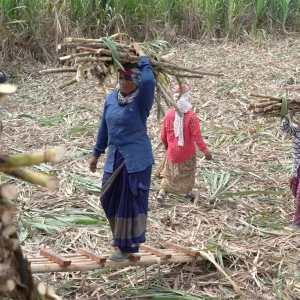
In Ramanal, a remote rural area of Karnataka, Purnima's day begins at four in the morning. She leaves her temporary tent and bathes before the men wake, then starts another day of cutting sugarcane. Like many of the women in these makeshift shelters, she has travelled more than 500 kilometres from her home village in search of work to repay debts. A recently published international report has laid bare the harsh reality of these workers' lives.
An estimated 1.5 million people cut sugarcane in India. Working shifts that often last 14 hours, they earn just 400 rupees a day. They work in pairs, usually husband and wife, cutting from dawn until night and pausing only while the cut cane is loaded onto trucks.
India produces 16 percent of the world's sugarcane, second only to Brazil in volume. Cane from this region is regularly supplied to beverage giants such as Coca-Cola and PepsiCo — meaning the sweat of these workers sits behind a major global industry.
Most of the workers in these fields come from the Beed area of central Maharashtra. With few employment opportunities at home, they choose this gruelling labour to feed their families, migrating hundreds of kilometres every season with debts hanging over them.
For many women, the physical demands are only part of the challenge. A deeper concern is the pressure some face to put their own reproductive health at risk in order to keep their jobs. Living in temporary camps without toilets or clean water, women workers confront an impossible reality every day.
In such conditions, managing menstruation is not only exhausting but financially ruinous. In a system where missing a single shift means wages are docked, there is no room to take a day off for period pain. Women are left with a brutal choice: care for their bodies, miss work and pay fines — or keep working and accept long-term health risks.
Purnima says that if someone could free her from this pain, it would be an enormous help. She is seriously considering having her uterus removed as a solution. The suffering is not easing, she says, and it will only grow if she continues this work. Stopping the heavy lifting might help, but the family has no other way to survive.
Sugarcane cutting is seasonal work on which many Beed families depend. Each year, contractors known as mukaddams organise the migrant workers, liaising with sugar mills, arranging transport and handing out advance payments. Each couple, known as a koita, must then work off that advance, expected to cut an average of three tonnes of cane a day.
Because income is shared among groups of seven or eight koitas, everyone is under pressure to keep pace with the rest. If a woman cannot work, the other couples who cover the shortfall collect a fine from her. Illness, in effect, offers no way to stop.
Another worker, Sabita, was driven to decide on a hysterectomy in March 2025. She recalls that no one in the field would help and rest was simply not allowed. Suffering abdominal pain, she fell three times the previous year while climbing a ladder to load a truck, yet could not even complain.
Purnima's account is the same: after arriving, she works every day for four to five months straight, with no leave at all. Three years of unrelenting pain have pushed her towards surgery, but even deciding on the operation may mean taking on yet another loan to pay for it. Even giving up her own womb requires borrowing, she says, adding that it feels as if her body has become a slave to the system.
The problem is not new. In 2019, a Maharashtra government committee surveyed 82,309 women who had migrated to Beed for cane cutting and found that 13,861 of them had undergone hysterectomies. More than 45 percent of those women later reported physical or mental suffering. The government introduced some monitoring and welfare measures, but workers say little has changed on the ground.
In March 2025, the Bombay High Court directed the regional government to introduce proper registration and improved access to welfare and healthcare, among other measures. A follow-up report due in November was never published. Both Purnima and Sabita say they have received no welfare support from the government at all. Purnima alone spends 50,000 rupees a year on painkillers, she says.
Beed's district collector, Vivek Johnson, repeatedly declined to comment on the report. Coca-Cola said it has partnered with the international civil society organisation Solidaridad to expand workers' access to clean water, sanitation, shaded rest areas, ergonomic tools and women's hygiene products, claiming 100,000 people have benefited. PepsiCo was also contacted but did not respond.
According to the women and those who support them, many workers feel pressured into extreme steps to avoid period pain and pregnancy breaks altogether. They argue that changing this cruel working environment for women requires fundamental reform of how agricultural labour in India is structured and regulated. For women like Purnima, the question is when court orders and government promises will finally reach the fields.