Students Falling in General Schools, Rising in Madrasas and English Medium: BANBEIS Data Raises Deep Questions Over Education System
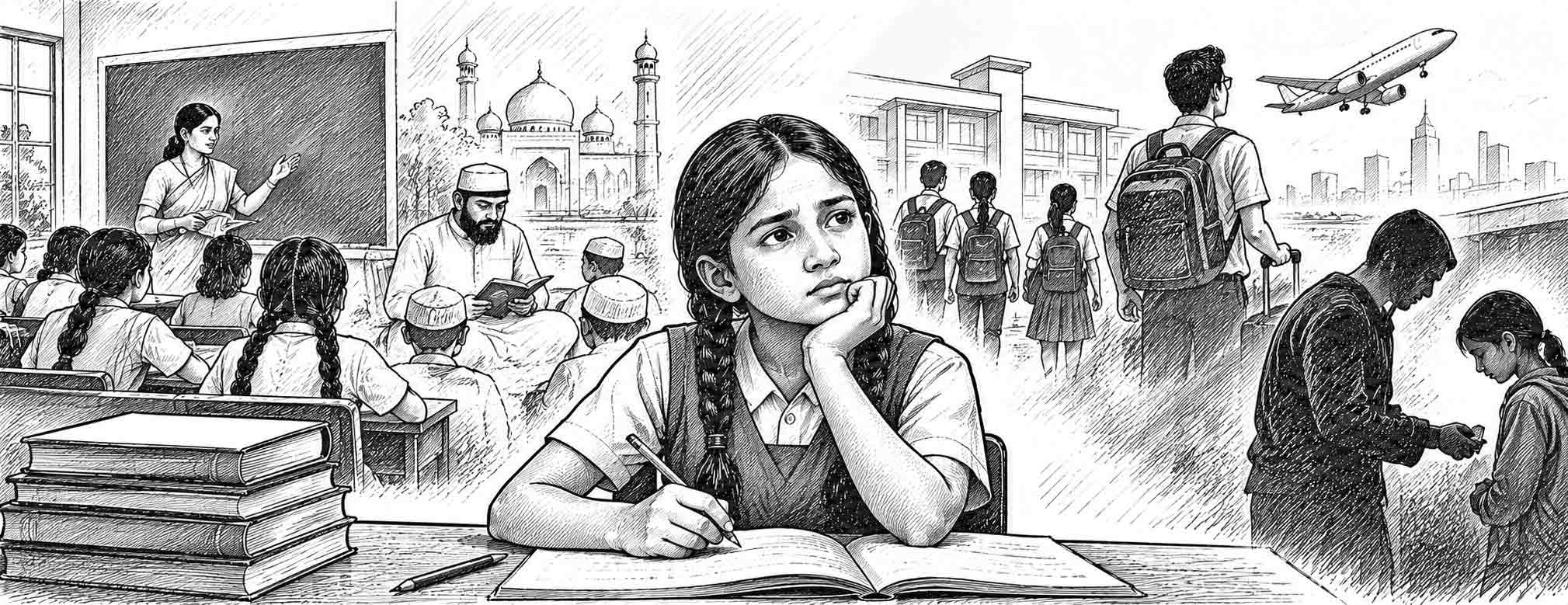
The number of students in Bangladesh's general Bangla-medium schools is falling at an alarming rate, while enrolment is rising in madrasas and English-medium institutions, according to a recently published report by the Bangladesh Bureau of Educational Information and Statistics (BANBEIS). The trend had been under way for a long time, but its pace has accelerated sharply since 2024, commentators say.
Why madrasa education has grown so strong in place of general education is itself a question the state has a major duty to investigate, analysts argue. How this stream of education was encouraged, and what its relationship with politics is, also needs to be examined.
In a country whose state language is Bangla, all work in offices and courts everywhere should be conducted in Bangla — on that logic, many have long warned of the dangers of running multiple parallel systems of education. It is mainly students educated in Bangla who staff the country's administration and government and private institutions.
Students educated in the English medium, by contrast, often study with the dream of going abroad, and a negative attitude towards the country can develop among them, the discussion notes. Only the children of the wealthy can afford English-medium institutions, and this education leaves them largely disconnected from the country's culture, it is argued. Some jobs exist for them in multinational companies at home, but their dreams are essentially built around foreign countries.
The madrasa picture is not simple either. Several streams exist within madrasa education itself. Although madrasa students can now enter public universities, no real future is being created for them in banking or international trade. Poverty, religious motivation and the prospect of small jobs in mosques and madrasas after graduation lie behind madrasa enrolment; those skilled in religious sermons may have an earning future, though in a limited field, and star status is possible for a few. The same statistics also show that madrasas suffer from a shortage of skilled teachers.
With no shared culture in education, a deep divide has also appeared in the formation of values. Parental and teacher neglect has added to this, and it is alleged that genuine values are not being built in the education system at all. With a few exceptions, most teachers see school only as a place to earn money, the discussion says in a harsh assessment.
Coaching centres have now spread through schools, colleges and universities. Coaching arrangements exist for admission at every level, and it is alleged that nearly all teachers are immersed in this coaching trade. For teachers seeking quick income, there is no easier alternative — a reality seen as driving the spread.
For a long time, government authorities, managing committees, guardians and local influentials have neglected primary schools. On the other hand, the entry of religion-based politics into the education system has been identified as a major crisis of madrasa education — influential teachers joining politics is making the system sicker, commentators say.
Education now has many separate directorates — one for secondary and higher secondary, another for madrasa education, and separate government bodies to oversee English and Arabic streams. Senior officials of these directorates and many of those running education at upazila, district and divisional levels also face allegations of major corruption in the discussion; school managing committee chairmen and members, and some teachers, are said to be involved. If students understand a teacher's corruption at a young age, protecting them from its effects becomes impossible, the discussion warns.
News emerging about various madrasas is also described as alarming — an oppressive system of education is still in place there, and children are subjected to sexual abuse by teachers, it is noted. The problem is grave, the commentary says.
Widespread errors in teacher recruitment, the rise of coaching centres, and rote learning becoming dominant while trying to apply creative methods have together damaged the whole education system, the discussion argues. Many colleges were established and the number of universities grew, but teacher quality kept declining, while nepotism, corruption and ruling-party influence in recruitment crippled the system further. The Qudrat-e-Khuda education commission was never implemented, and later education commissions remained a cause of harm, it is said.
As a remedy, it is argued that no government alone can free society from corruption — sweeping change must be brought to the education system on one side, and a society of honest people built on the other. Learning from countries advanced in education, such as Finland, is also urged; with the window to the world open, why Bangladesh is not taking those lessons is the question raised. The discussion ends with a call for swift action without delay.