Hundreds Wade In With Polo Traps at Dawn: Manikganj's Traditional Fishing Festival Renews Calls to Protect Native Fish
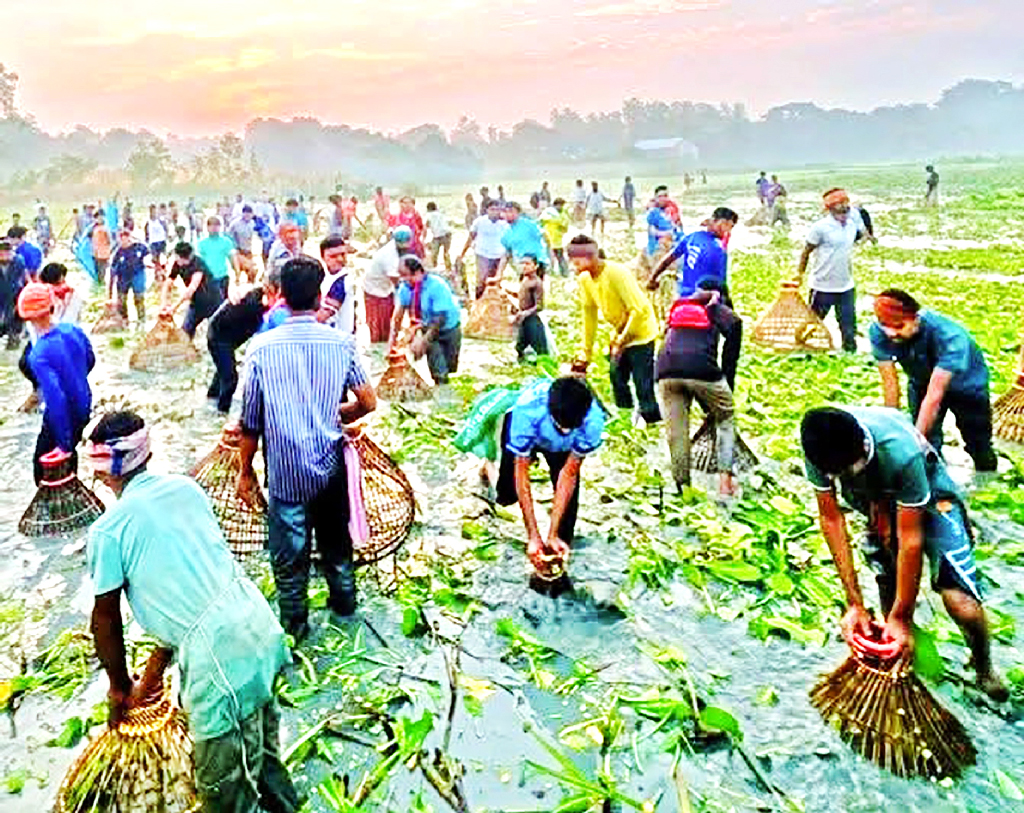
As dawn broke, people of all ages waded into the wetlands carrying polo — the traditional bamboo fish trap. Some caught boal, shol or rui in their traps; others returned empty-handed. Such scenes were seen early on Friday in several wetlands at Rathura Chak in Ghior upazila of Manikganj, where the fishing gathering turned into a festival and a reunion of relatives and friends.
Early on Friday, more than a hundred amateur fishers took part in polo fishing in wetlands at Tara, Mirzapur and Rathura Chak in Baniajuri union. On the same day, a polo race was also held on a branch of the Ichamati river. It began at Bardia in Uthuli union, crossed the Karjana bridge area and ended near Thakurkandi village in Ghior, with at least 300 fishers taking part along nearly three kilometres of river. Fishing had also taken place the previous day, Thursday, in wetlands at Sholdhara and Nayachar.
Throughout October, polo fishing is organised in various wetlands and rivers of Ghior, but the largest crowds gather on Thursdays and Fridays. News of the polo race is spread in some places by beating drums at markets and in others by loudspeaker announcements, and people arrive at the appointed place with traps in hand from different areas.
Nurul Karim Babu of Baniajuri said the polo race is a traditional fishing festival of rural Bengal. The event creates joy and excitement among people of different villages, and fishing together in groups strengthens bonds of friendship and harmony, he said.
Aziz Mia of Nakibbari village said he had joined the race at Rathura Chak wetland early on Friday and caught two karfu and one boal. While some were lucky enough to land big fish, many returned empty-handed — yet the festive spirit did not fade.
Fisher Islam Khan said: 'The joy of fishing with a polo is something else. Along with catching fish, you meet friends and relatives and everyone enjoys together. May this tradition never be lost.' Another fisher, Mahfuz Bhuiyan, said: 'Even if you catch few fish, the joy of stepping into the wetland with a polo does not diminish. Everyone celebrates over who caught the biggest fish. We wait for this event every year.'
Barak Mia, an elderly resident of Ghior, said: 'In the past the wetlands were full of native fish. When you went in with a polo, many caught big fish. People came in groups from different villages. Now fish have declined in many places. Yet people have held on to the tradition.' His words underline the contrast between past abundance and the present shortage.
In earlier times, from Kartik to Magh, as the water receded, polo fishing would begin in earnest in rivers, canals, beels and wetlands. Such events were also held on Manikganj's Ichamati, Dhaleshwari, Kaliganga, Gazikhali and Kantabati rivers. The practice continues today, but far less than before.
Delwar Jahan, director of Ghior's Natural Agriculture Centre, said: 'The polo race is part of our rural heritage and harmony. Alongside keeping this event alive, everyone must be conscious about protecting wetlands and native fish.' Baniajuri union parishad chairman S R Ansari Biltu said polo fishing is not merely a fishing event but a gathering of rural people and a reflection of folk culture carried from generation to generation, and that the tradition will survive if wetlands and native fish are protected.
Bimal Roy, Manikganj regional coordinator of the private agriculture, environment and fisheries research organisation BARCIK, said emphasis must be given to protecting wetlands and native fish breeding grounds to preserve the polo tradition. Local people allege that the use of current nets, catching fish fry, draining wetlands to catch fish and the use of poison are reducing the number and diversity of native fish.
Bartia union parishad chairman Shamsul Alam Rowshan said: 'The long-standing polo race brings vibrancy among people of surrounding villages. But because of current nets, fry catching, wetland draining and poisoning, the number and diversity of fish species are declining. To preserve this tradition, public awareness as well as cooperation from all concerned, including the fisheries department, is needed.'
Alongside the fishing, participants were delighted to meet friends and relatives and to be part of an old tradition. Whether this culture, sustained for generations, will survive depends largely on whether the wetlands can be saved and native fish breeding grounds protected — that was the warning local people sounded even on the day of the festival.