With Power and Water Cut, Worshippers Cross Rubble to Pray at Delhi’s Century-Old Race Course Mosque
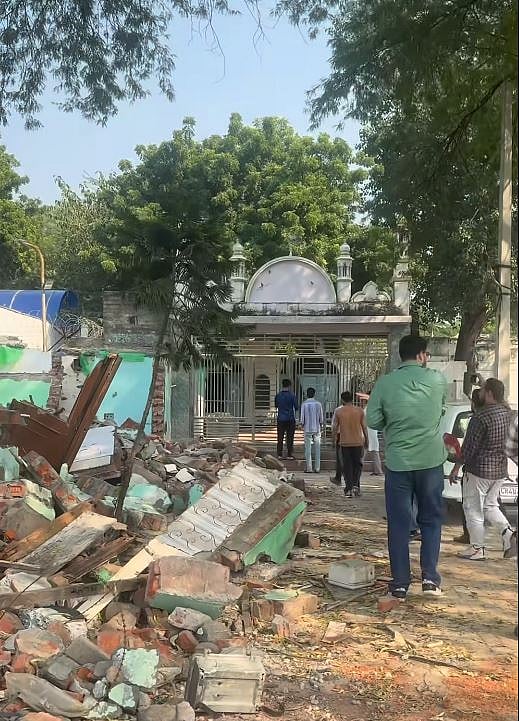
Despite fears of eviction by the administration, cut-off electricity and water supplies and tight security, worshippers offered Friday prayers at New Delhi's historic Race Course Mosque. Tension has surrounded the century-old mosque, located near the prime minister's official residence, for days.
Worshippers gathered there on Friday after crossing the rubble around the mosque. The prayers were completed peacefully, but strong anger was visible among a large section of worshippers over the administration's role. They allege the administration is behaving in a biased manner.
The local administration recently declared the Race Course Mosque illegal and issued an eviction notice. Even before the deadline expired, bulldozers were driven into the area adjoining the mosque, demolishing several homes and shops. Steps have been taken to relocate the residents elsewhere.
Not only in the capital Delhi, but in various parts of eastern India too, Muslims — a large share of them Bengali-speaking Muslims — are being evicted on allegations of illegal occupation, the report also alleges.
In the situation that developed, Section 163 of the Bharatiya Nagarik Suraksha Sanhita (BNSS) was imposed on Friday around the Race Course Mosque and its surrounding area. As a result, gatherings of five or more people and any kind of protest were banned. However, at the scheduled time of Friday prayers, police softened somewhat and allowed worshippers to enter the mosque and pray.
After the prayers, Aam Aadmi Party (AAP) leader Amanatullah Khan claimed he had held fruitful discussions with top officials of the Delhi Waqf Board, the NDMC and the authorities concerned. He also assured that the historic mosque is fully protected.
Local worshippers and their supporters expressed relief at being able to pray at the mosque and hoped a permanent solution to the crisis would come through discussion. But many worshippers present did not hide their anger.
Ashraful Khan, who came from Bihar, said that despite being the country's second-largest religious community, Muslims are being selectively targeted. Raising the same allegation, a young man named Amanullah said: "The government should rather say directly that Muslims are unwanted in this country. The administration has no sympathy for them."
Moidul Alam, a gardener from West Bengal working in Delhi, described the frightening situation: "There is no light, no water, only ruins beside us. An atmosphere of panic has been created in the mosque compound. When the imam was leading our prayers, tears came to his eyes. Seeing that, we all became very sad."
According to the chronology behind the events, the mosque's electricity and water connections were cut on 7 October. Then, on 15 October, when an application was made to the Delhi High Court to restore the connections, the court rejected it. The court said the Land and Development Office was conducting an eviction drive in the area, so restoring electricity in this situation could pose a risk to public safety. Since that court order, security in the area has been strengthened with paramilitary forces and additional police.
The mosque's imam, Maulvi Harun, alleges that on 17 October an official of the Land and Development Office verbally instructed him to vacate the mosque within just six days. The imam claims it is a registered Waqf-listed property with valid documents. Since services were cut, they have kept activities running with a generator.
Government sources, on the other hand, claim no eviction notice was formally given to the mosque authorities. Earlier, the Delhi Waqf Board had lodged a written protest with the NDMC over the disconnection without any prior notice. However, the court said the mosque's imam does not personally have the legal standing to file this writ and the Waqf Board did not directly approach the court.
Although Friday prayers ended peacefully, uncertainty over the mosque's future has not lifted. All eyes are now on whether a lasting solution comes through discussion.