
Bangladesh Falls Behind in Europe's Garment Market: Export Earnings Down €157 Crore in Eight Months as China and Vietnam Advance
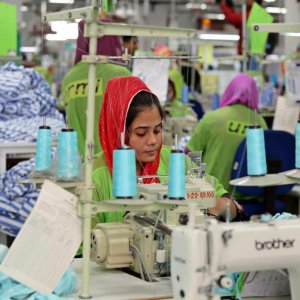
Bangladesh's ready-made garment exports to the European Union keep shrinking. According to Eurostat figures for January–August 2026 compiled by Bangladesh Apparel Voice (BAV), the value of Bangladesh's garment exports to the EU stood at €11.93 billion in those eight months — down 11.67 percent from €13.50 billion in the same period a year earlier. In other words, Bangladesh lost €1.57 billion in export earnings in just eight months.
China, by contrast, has strengthened its grip on the same market, and Vietnam has grown its exports too. China's share of total EU garment imports rose from 30.7 percent to 32.7 percent, while Bangladesh's share fell from 21.5 percent to 19.8 percent. The market's contraction hit everyone — but it hit Bangladesh harder than its rivals.
The overall picture offers little comfort either. In January–August, EU countries imported €60.29 billion worth of garments from around the world, down 3.83 percent year on year. Import volume fell 2.57 percent, and the average price per kilogram of clothing also declined, by 1.29 percent.
According to BAV's analysis, EU garment imports slumped sharply at the start of 2026. Imports in January–April fell by nearly 10 percent compared with the same period a year earlier; in January alone the drop was 15.48 percent. Inflation and weakening consumer confidence had led retailers to cut back on new orders.
From May, however, the situation improved somewhat. Relatively strong spring retail sales in Europe lifted new orders; imports rose in June–August to meet autumn and winter demand, and some shipments delayed early in the year also arrived. As a result, EU garment imports in May–August grew by about 2.6 percent year on year, and the eight-month decline narrowed to 3.83 percent. The market, in short, is recovering — but Bangladesh is not yet sharing in that recovery.
The reason lies in a fall on both fronts: volume and price. Bangladesh's garment shipments to the EU in January–August totalled 866.76 million kilograms, down 4.58 percent from a year earlier. The average price per kilogram fell 7.43 percent, to €13.76 over the eight months. BAV's analysis says the price drop accounts for the larger part of the earnings decline — prices have hurt revenue more than the fall in volume.
In the first two months of the year, Bangladesh's garment exports had fallen by 19 percent. Conditions improved later, but by the end of eight months export value remained significantly below last year's level — a measure of how slow the recovery has been for Bangladesh.
Its competitors tell the opposite story. Among the EU market's major suppliers, China is in the strongest position: it exported €19.71 billion worth of garments to the EU in January–August, up 2.38 percent year on year. China is the only major supplier whose export value and volume both grew.
Vietnam's exports rose as well: it shipped €3.00 billion worth of garments to the EU, up 4.46 percent, and its average price per kilogram climbed 10.11 percent — Vietnam is not just selling more, it is selling at higher prices. Pakistan's export volume rose 3.82 percent but its average price fell 12.96 percent, to €10.88 per kilogram, the lowest among major suppliers. Garment exports to the EU from Turkiye, India, Sri Lanka and Indonesia each fell by around 11 percent.
The outlook ahead mixes hope with risk. The European Commission's spring 2026 economic forecast projects EU growth of 1.1 percent this year, rising to 1.4 percent in 2027, with inflation easing to 2.4 percent. But the forecast rests on a big condition: stable energy prices. If the Middle East conflict drags on, energy, shipping and insurance costs could rise further; the Commission estimates the conflict could shave 0.3 percentage points off EU growth this year.
Another sign of the market's fragility came on October 17, when cost-of-living protests across France damaged around 1,500 shops, according to BAV's report; clothing stores' average sales fell 14 percent that day. Protests were also reported in Belgium, Italy and Portugal. If Christmas-season sales at the end of the year prove weak, European buyers may cut new garment orders in early 2027 — piling further pressure on Bangladeshi exporters.
Policy change adds another layer of pressure. The EU's new GSP (generalised scheme of preferences) rules, due to take effect from next January, and the planned India–EU free trade agreement will matter greatly for Bangladesh; both could intensify competition in the European market.
On what needs to be done, the message from Mohiuddin Rubel — a former BGMEA director and the founder and chief executive of BAV — is blunt. Europe's garment import demand shows signs of a slow recovery, he says, but Bangladesh's exports remain under pressure, with falling average prices cutting earnings the most. Simply chasing higher volumes will not be enough; exporters must raise value addition and move into comparatively higher-priced garments.
Rubel adds that China's exports to Europe are rising and Vietnam is performing well, making competition tougher for Bangladesh. Energy prices, transport costs and European buyers' uncertainty will also shape exports in the days ahead. He urges exporters to strengthen long-term relationships with buyers, diversify products, raise production capacity and ensure on-time delivery. Warning that possible changes in Europe's trade policy in 2027 and a free trade deal with India could create fresh competition, he calls for close monitoring of the market and improvements in quality, productivity and competitiveness — arguing that Bangladesh must lean on its core strengths, production efficiency and supply capability, to hold its position in Europe.
The message, overall, is clear: Europe's garment import market shows signs of recovery, but Bangladesh remains under pressure. China's growing market share, Vietnam's advance and the trend of falling average prices together pose a new challenge. Exporters will now be watching Christmas sales and the new year's orders — the two indicators that will show whether this blow is temporary or long-term.