India and China Troops Still Face to Face on Arunachal Border, ITBP Admits for the First Time
India has officially acknowledged for the first time that tension has spread between the Chinese and Indian armies along the border of its northeastern state of Arunachal Pradesh. Indo-Tibetan Border Police (ITBP) Director General Shatrujit Kapoor said face-offs between the two countries’ soldiers have developed at several places on the border and the situation is still continuing.
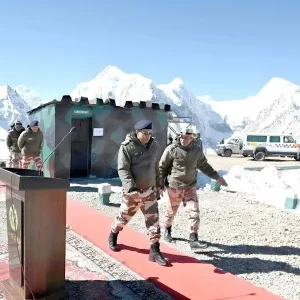
Kapoor spoke on Thursday (22 October) at the annual honours ceremony ‘Himveer Samman Samaroh’ at the ITBP Central Training College in Alwar, Rajasthan. He said ITBP commandos are currently in those face-off positions amid the border tension.
The director general said that over the past few days, situations resembling face-offs between the two armies have arisen at several places in Arunachal and are still continuing, adding that their newly raised ‘Shaurya’ commandos have played an exemplary role in them.
Kapoor also said the ITBP was originally raised as a mountain guerrilla force and was given responsibility for guarding the China border in 2004. He said the force would not move away from its core role and that a specialised unit for warfare in high mountain regions is being built outside the army.
A full battalion of ‘Shaurya’ commandos will be raised soon, he said, noting that deployment in high-altitude areas is this force’s strength, which is why its role in the difficult border terrain is being given special importance.
The ITBP chief also announced a plan to build underground shelters on the China border, saying a decision has been taken to build, within the next three years, as many underground shelters as there are overground structures on that border.
Explaining the decision, he said underground shelters are extremely important in modern warfare, because any structure above ground can become a target, so underground shelters are being prioritised for a war situation.
Pilot projects are currently running in every company, aimed at building convenient permanent defences with adequate bathrooms, ventilation and drainage. Once the design is finalised, an equal number of underground and overground structures will be built at every border outpost within three years.
Citing government sources, an Indian news agency reported that since late July, India and China have been in a face-off at the ‘Asaphila’ area near the ‘Maja company operating base’ in the Taksing circle of Upper Subansiri district in Arunachal Pradesh. China’s People’s Liberation Army (PLA) is reported to have pitched tents at a height within 6 to 7 kilometres of India’s perception of the Line of Actual Control (LAC).
According to the report, Indian and Chinese soldiers came face to face near Maja during a regular patrol in July. After a brief argument both sides stepped back, but a few days later China returned with a large number of troops and set up tents, prompting India to increase its own deployment there in response.
The border standoff has continued even amid diplomatic talks. Chinese President Xi Jinping attended the 18th BRICS summit held in India from 11 to 13 September, and three high-level border meetings have been held between the two countries since July.
They include the 36th WMCC meeting on 6 August, the 25th Special Representatives meeting in Beijing on 26 August attended by India’s National Security Adviser Ajit Doval, and the first Eastern Sector corps commander-level meeting at the Bacha-Damai point in Arunachal Pradesh on 6 September. Since the Galwan clash of June 2020, such meetings had mainly been held at the Chushul-Moldo point in eastern Ladakh. Attention now rests on the next diplomatic steps and whether talks can bring the tension down.