
No Lifeguards Beyond Three Kilometres and Hidden Channels Growing: Drowning Deaths at Cox's Bazar Beach Keep Rising
Twelve tourists in two groups from Dhaka and Chattogram were bathing in knee-deep water on a quiet stretch of beach in the afternoon when large waves began crashing over them one after another. The sand slipped away beneath their feet and one whole group was swept out. Five people died in the incident at Himchhari beach in Cox's Bazar on Wednesday afternoon.
The incident happened at Pechardwip in Himchhari, Ramu upazila, about 18 kilometres from Cox's Bazar town, on the beach beside the Marina Resort museum. The last of the missing, university student S M Nafisur Rahman Nibir, has since been recovered dead. His body washed ashore at Kalatoli Bhangarmukh beach around 8pm on Thursday, roughly 26 hours after he went missing, taking the death toll to five. Another young man, Rakib Hasan (19), remains in critical condition in treatment.
Mohammad Sani of Chattogram, who survived, said: 'We had gone in up to our knees. Suddenly big waves kept crashing over us one after another. We were being carried away by the reverse current. Everyone was floundering. The sand was slipping from under our feet. Somehow five or six of us managed to get back to shore, but six people went under.'
Such incidents have now become almost routine at Cox's Bazar. Inadequate lifeguard services, bathing in the sea during hostile weather, and entering deep water without knowing how to swim are driving the accidents up, according to those involved in rescue work.
According to Sea Safe Lifeguard, a private organisation rescuing tourists since 2014, 86 people drowned in the Laboni, Sugandha and Kalatoli areas between 2015 and October this year. Over the same period, 1,120 people were rescued alive.
An analysis of the data shows 46 of those deaths occurred in just the last three years — 20 last year and 12 the year before. In 2022 and 2023, by contrast, six tourists died in each year. The death rate is rising fast.
By September this year, nine people had already drowned at sea, and a man named Helal Uddin of Meherpur Sadar remains missing. The latest Himchhari incident has pushed the toll higher still.
The previous major accident also happened at this same Himchhari beach, in July 2025, when three students of the University of Chittagong died while bathing. Another student of the university's development studies department, Aritra Hasan, has never been found.
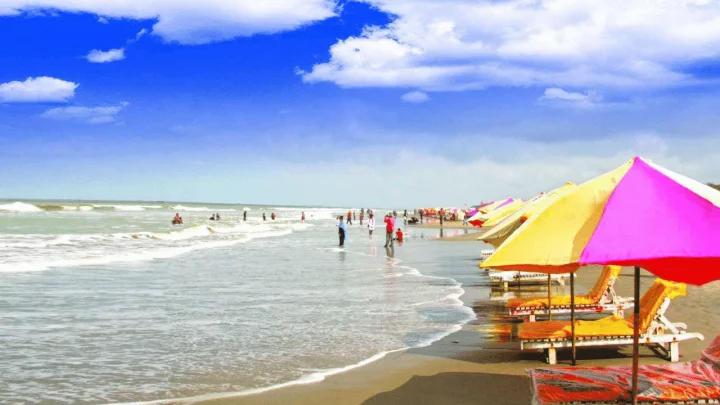
The Cox's Bazar sea beach runs for about 120 kilometres from Nazirartek to Badarmokam in Teknaf. Yet rescue arrangements for bathers in trouble exist only along a three-kilometre stretch of the town beach, from Laboni to Kalatoli.
Beyond that stretch, thousands of tourists bathe every day at Dariyanagar, Himchhari, Inani, Patuartek and several beaches in Teknaf. In those areas there is no immediate rescue arrangement if someone falls into a hidden channel or is caught by a reverse current.
Oceanographers and meteorologists say climate change is causing frequent shifts in sea weather and wave patterns. As tidal water slams into the shore with great force, hidden channels and deep holes are forming at various points along the beach, turning into death traps for tourists.
Mahbub Alam, supervisor of the district administration's beach workers, said recent heavy rain and a rough sea have created hidden channels and large holes at various points. Risky spots are being marked with red flags and tourists are being warned by loudspeaker, but these measures do not exist on the secluded beaches.
This year, cautionary signals for hostile weather were hoisted at sea at least 11 times. Rough conditions have prevailed since April, and although the sea was expected to calm from mid-October, it remains rough. Hill runoff and tides have broken down sand ridges in places, creating hidden channels and deep trenches.
Mohammad Abdul Hannan, assistant meteorologist at the Cox's Bazar weather office, said the risk of cyclones or severe weather lasts until November, so it is essential to know the tide schedule and the weather before entering the sea.
Scientists at the Bangladesh Oceanographic Research Institute (BORI) have been researching beach erosion and hidden channels since October 2024. Their work shows the beach structure is changing frequently due to climate change and human activity. Abu Sharif Md Mahbub-e-Kibria, head of BORI's marine environment and climate change division, said abnormal weather behaviour is increasing under global warming and climate change, with a major impact visible on the Cox's Bazar coastal ecosystem for the last four to five years.
Cox's Bazar Citizens' Forum president A N M Helal Uddin said tourists arriving by bus, rail and air must be told the warnings and how to avoid danger before they go down to the beach, and movement on risky beaches must also be controlled.
The question is now plain: for how long can thousands of tourists be left at risk every day along a 120-kilometre beach where rescue cover exists for only three kilometres? The five lives lost at Himchhari have put that question back in front of everyone.