France's Fast-Track Riot Courts Overwhelmed as Lawyers Say the Answer Should Be Political, Not Legal

Awa, 18, stood in the dock in the tribunal de Paris, a small and bewildered figure who seemed unable to understand, let alone answer, the simplest questions. The court was told she had joined young people who looted an Yves Saint Laurent store on Boulevard Saint Germain in Paris's Left Bank late on Sunday and stripped it bare within minutes.
Awa was arrested at a nearby Metro station with a black balaclava and black gloves in her backpack along with four YSL handbags worth a total of €5,000. In the dock, dressed entirely in black — the clothes she was wearing when arrested two days earlier — she appeared panicked, clutched at her hair and picked her lip. Unable to speak, she covered her face and began to weep, first silently and then uncontrollably, her sobs punctuating an almost palpably painful silence.
Awa was just one of 2,500 people arrested during last weekend's rioting and looting across the country, more than 900 of whom are being fast-tracked through the courts using a procedure called comparution immédiate, or immediate appearance. It sends them to trial straight or shortly after being taken into custody, or within three days if they are held in pretrial detention.
The process of handling this sudden influx of cases has overwhelmed the courts and angered defendants' lawyers, who say they have no time to meet with clients. In their view, many hearings are moving forward without proper legal preparation in the name of speed.
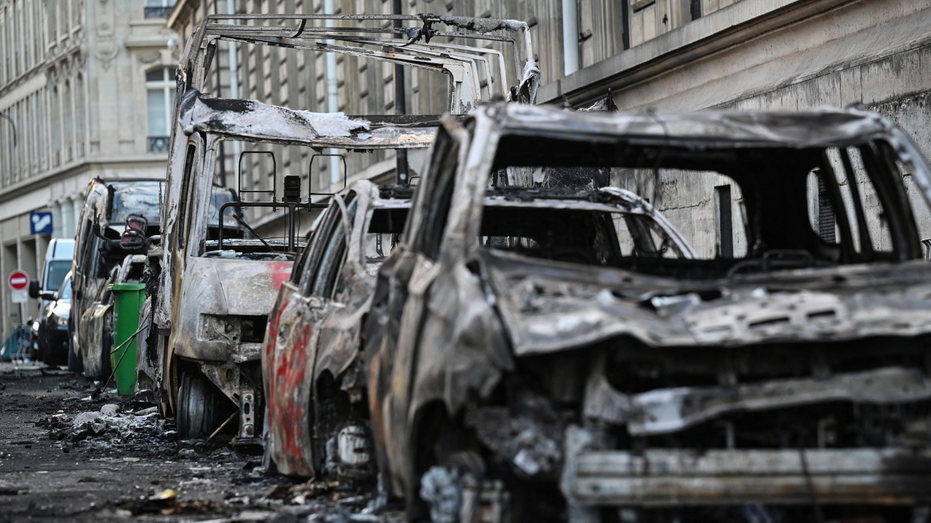
The violence erupted after high-school student and union demonstrations. In Paris, the authorised march passed through the capital without major incident. But on the fringes and afterwards, black-clad, masked people rampaged through cities and towns, setting fire to public buildings, bikes and rubbish bins, smashing up restaurants and shops, and looting local and luxury goods stores.
Initial reports blamed the destruction on those protesting against a raft of unaddressed grievances against President Emmanuel Macron and successive governments, including ultra-left disrupters. The reality was, in many cases, more prosaic. Most of those charged with vandalism, violence, theft, or damaging public or private property appeared to have been what officials have described as opportunistic delinquents with mundane rather than political motivations.
The majority were young men. In Paris, 68% of those taken into custody were adults, according to the public prosecutor's office, not high-school teenagers. As police escorted defendants into court from the cells where they had been held since their arrest, it was clear that, apart from black clothing, they could not be categorised. Some were confused, others more confident. Many, like Awa, seemed completely non-plussed at finding themselves before a judge whose first question was: Do you want to be tried now or later?
Laure Beccuau, the Paris public prosecutor, told French radio: 'The vast majority of those we've sent to the courts have never been convicted before.' Most were young and unemployed, others in work with families, such as Aboubacar, 23, employed by the charity Emmaüs; Boumedine, 25, a TikTok influencer; Oussama, 37, a delivery driver; and Victor, 21, a student who appeared in court with a black eye, accused of attacking a police officer.
Similar pictures emerged in other cities. In Lyon, Yanis, 20, a restaurant worker, was caught with a friend with 30 pairs of trousers and two jackets from Zara. Nathan, from Perpignan, was arrested carrying fireworks, often used to fire at police. Julien, 27, a freelance artist, was accused of serious and worrying behaviour for throwing a traffic cone at a police car.
Lamine, 38, a builder, was discovered inside the Louis Vuitton concession at the Printemps department store in Paris, with Sofiane, 34, an Amazon worker, after the building's grills closed in an emergency lockdown on Saturday. Lamine said he had gone to buy clothing for his five children, but the court heard his criminal record included convictions for violence, theft, resisting arrest and contempt of court. The pair, found with €37,000 of luxury goods, were convicted: Lamine was sentenced to semi-release, allowing him to work during the day but return to prison at night, and Sofiane was ordered to wear an electronic bracelet for six months.
A 19-year-old student with no previous criminal record who had taken part in the official march was caught on his way home with several stolen black pullovers from a looted clothing store. He was fined and given a 14-month suspended prison term, a sentence his mother said was too severe. 'It was just a question of opportunity,' he said. 'I thought: everyone else is doing it why not me? I regret it.'
The justice minister, Gérald Darmanin, had extended the time those arrested could be held in police custody from 48 to 72 hours and called for courts to be extremely firm and ruthless towards the casseurs, or rioters and vandals. In response, 125 lawyers wrote an open letter to the president of the Paris bar association denouncing the ultra-repressive turn taken by the Paris public prosecutor's office. They wrote that the nationwide protest on October 17 had revealed a historic, politically motivated, orchestrated and deliberate crackdown, and that they refused to allow summary trials to become the tool of a political response to social anger.
Back in court, Awa managed to explain in mumbles and monosyllables that she had stolen the bags to sell, and regretted it. Her lawyer, Hamma Bouchareb, told the court her client, who passed her baccalaureate and was studying for an advanced technical diploma in international business, has been living in sheltered care since fleeing her violent father who beat her, forced her to take cold showers, fractured her skull and broke her arm. 'She's only just 18 and barely out of childhood. She can hardly express herself. Awa stole and I am not excusing that, but she stole because she needs money,' she said.
Bouchareb added that the immediate court appearance is complicated and reflection is needed on what is being done. These people have lost their bearings and are afraid, she argued, and the response to the outbreak of anger should be political not legal, because politicians are responsible for an economic situation in which some do not have money to buy food or clothing. The lawyer representing Yves Saint Laurent said he would not seek to aggravate the situation but pointed out two of the company's stores had been looted and hundreds of bags taken. The prosecutor agreed it was a sad situation and would not seek a custodial sentence. Awa was given a 12-month suspended sentence, ordered to pay a fine and damages, and perform 140 hours of community service.