

Four Initiatives to Ease Dhaka Traffic: Removing Old Buses, Relocating Terminals, Reforming 31 Routes and an Auto-Rickshaw Policy
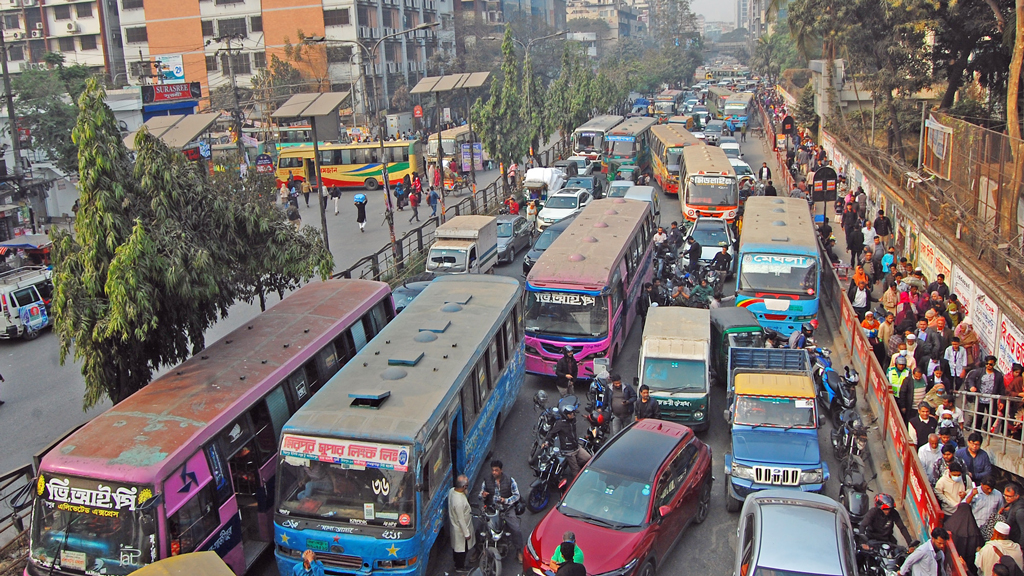
The government is planning to implement four initiatives to reduce traffic congestion in the capital, bring discipline to public transport and improve the quality of passenger services. The initiatives include removing buses more than 20 years old from the roads, relocating bus terminals in important areas, reforming 31 old road routes, and formulating a policy to regulate the movement of auto-rickshaws.
The initiatives were learned of by speaking to officials concerned at the Ministry of Road Transport and Bridges and representatives of the bus owners' association.
Habibur Rashid Habib, state minister for road transport and bridges and for railways, said: "It is difficult to achieve the desired result in eliminating the capital's traffic congestion if steps are taken in isolation. The government is seriously considering implementing all the initiatives — removal of old buses, terminal management, road route reform and regulation of auto-rickshaw movement — under one coordinated plan."
He said the main goals in this regard will be to reduce passengers' suffering, ensure road safety and make the public transport system more effective. According to those concerned, if the four initiatives are implemented in a coordinated way, there will be an opportunity to reduce vehicle pressure on the capital's roads, improve public transport movement management and strengthen road safety.
The capital's congestion puts extra pressure on the urban economy, working hours, fuel costs, public health and the environment. Every day, huge numbers of people have to spend long hours on the roads travelling to workplaces, educational institutions, hospitals and businesses. This reduces productivity and disrupts city dwellers' normal lives. Experts say Dhaka's congestion cannot be solved sustainably just by building new roads and flyovers; effective use of existing roads, bus route and movement management, vehicle quality control and coordination among different modes of public transport are also essential.
A portion of the old and unfit buses running on the capital's roads pose risks to road safety and the environment due to mechanical faults, lack of proper maintenance and excessive smoke emissions. In this situation, the initiative to remove buses more than 20 years old is being seen as a step towards improving public transport quality. However, if removing old buses creates a supply shortage in public transport, passengers' suffering may increase; arrangements for alternative buses, verification of the actual number of vehicles and phased implementation are important here. Driver training, fixed working hours, regular fitness tests and effective oversight of maintenance also need to be ensured.
In important areas of the capital including Sayedabad, Gabtoli, Mohakhali and Gulistan, bus pressure, passenger boarding and alighting, parking and the entry and exit of inter-district buses affect urban movement. Relocating terminals in these areas or improving their management could create an opportunity to reduce bus pressure on central roads. However, the location of new terminals, road connectivity, passengers' travel time, fares, safety and connections with other public transport must be considered. Even if terminals are moved to the city's edge, passengers' suffering may increase if there are not enough buses, metro rail or other transport connections from there to their destinations.
The initiative to reform the capital's 31 old road routes can also create an opportunity for change in public transport management. Route reform is not just about repairing road surfaces; bus routes, passenger boarding and alighting points, stoppage locations, connecting roads and vehicle entry and exit arrangements also need to be considered. On various roads in Dhaka, competition among multiple bus companies on the same route, buses stopping outside designated stoppages and sudden lane changes to pick up passengers disrupt traffic. Routes could be rearranged considering passenger movement data, busy hours, the locations of educational institutions and hospitals, and connections with the metro rail and other transport.
Formulating a new policy to regulate auto-rickshaw movement on the capital's roads is also part of the government's plan. In particular, there has long been concern in various quarters over battery-run three-wheelers, congestion and road safety. The new policy could determine vehicle registration and identification, driver qualifications, safety standards, permitted operating areas, parking, passenger boarding and alighting, and measures for law violations. But without alternative transport arrangements, designated stands and a realistic implementation plan, simply imposing bans cannot bring a sustainable solution.
Dr Mohammad Ziaul Haque, secretary of the Road Transport and Bridges Division, told BSS: "Alongside adopting plans to improve the transport system, an implementable action plan, distribution of responsibilities and regular progress evaluation will be done. If the initiatives are implemented keeping coordination among the agencies concerned, it will be possible to bring positive change in establishing discipline on the capital's roads and improving passenger service quality." He said public interest, road safety and easy availability of public transport will be given priority in this regard.
To implement these initiatives, effective coordination is needed among the Ministry of Road Transport and Bridges, the Bangladesh Road Transport Authority (BRTA), the Dhaka Transport Coordination Authority (DTCA), Dhaka North and South City Corporations, the traffic police and transport owners. Which agency will do what work, in how much time, and how progress will be evaluated must be specified. Ensuring transport worker training, bus fitness tests, control of illegal parking, effective designated stoppages and consistency in enforcing traffic laws is also essential.
According to those concerned, the effectiveness of these initiatives could be measured using indicators such as buses' average journey time, waiting time at stoppages, duration of congestion, road accident rates, passenger numbers on public transport and regular operation of transport. To gain the benefits of the initiatives, a specific action plan, implementation timeline, alternative transport arrangements and effective coordination among the agencies concerned must be ensured.
All eyes are now on the government's next step. How much relief the congestion-weary city residents get will depend on when the four initiatives move from paper plans to the implementation table, and how quickly their reflection is seen on the capital's roads.



