Pay 'Bit Money' and an Auto-Rickshaw Can Run on the Highway: Ban on Paper on the Barishal-Dhaka Road, Traffic in Reality
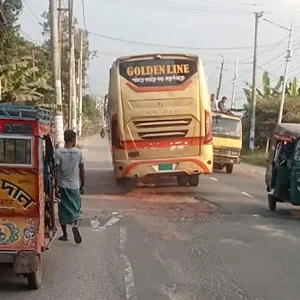
To control accidents, three-wheeled vehicles are banned on the Barishal-Dhaka highway. But in reality, defying that ban, battery-run rickshaws, auto-rickshaws, CNG-run auto-rickshaws and various other small vehicles are plying the highway. The question keeps coming up — how are these vehicles running despite being banned?
Drivers say the opportunity to run on the highway comes through weak police surveillance, lobbying by local influential people, and paying 'bit money' in the name of workers' organisations. This disrupts the movement of large vehicles including buses and trucks and raises the risk of accidents — even the drivers themselves say this cannot be denied.
'Bit money' means the regular toll collected by workers' organisations or concerned workers' leaders in exchange for allowing banned small vehicles to run on the highway. If police seize a vehicle, they also arrange its release through lobbying by the workers' leaders — for which drivers have to pay extra money as well. As a result, a parallel money system has grown up alongside the ban.
Those concerned have questioned the ban's effectiveness in reality, despite administrative drives and the prohibition. Their complaint is that many drivers of these vehicles that run defying the ban lack the necessary experience. As a result, accidents happen often; besides deaths, many have to go to hospital injured, and some become disabled.
Mohammad Yusuf, a resident of Shikarpur in Ujirpur on the Barishal-Dhaka highway, was once involved in floating business. After being evicted from there, he could not return to business. Even though he built a shop by the highway, his path of income eventually closed. In hardship with his family, he started driving a battery-run rickshaw out of the need to earn a living.
Yusuf takes to the road every day with a rickshaw rented for Tk 300. He says the biggest problem in running on the highway is the traffic police and highway police. Although small vehicles are banned, many drivers get the chance to drive on the highway by paying 'bit money' to a workers' organisation. Because he did not pay that money, his vehicle was frequently seized at first.
At first, Yusuf tried driving the rickshaw on local roads in Ujirpur. But with few passengers there, he struggled even to raise the vehicle rent, and running the household became difficult. Finally, hoping to increase his income, he started driving on the highway by paying bit money to the workers' organisation. For this, he has to pay Tk 10 daily to a designated person; again, crossing a designated area, he has to pay another Tk 10 at another place. Throughout the day, those people collect bit money from these vehicles at various points on the highway.
Yusuf says, 'Driving a small vehicle is an easy profession. And since this profession pays cash, earning is also easy. But the problem is charging the battery and managing the traffic police to run on the highway.' He says, 'Everything can be managed and movement is possible. But sometimes the police members in charge of the highway seize the vehicle even after taking bit money. If the vehicle is damaged, the drivers have to bear the entire cost. The owner's clear word is that the vehicle must be returned as it was taken. Even if there is a case, the driver has to handle it. And if the vehicle is confiscated, the price of a new vehicle has to be paid.' Drivers are forced to rent vehicles accepting these conditions.
Abu Saeed has been driving a battery-run auto-rickshaw for a long time. He says running on the highway alongside large vehicles is extremely risky; yet they are forced to take this path thinking of their families. Saeed said that when he is at home, his 14-year-old son also drives the auto-rickshaw carrying passengers. Despite the fear that a major accident could happen at any time, they are forced to take the risk out of the need to earn. When work is scarce in rural areas, the demand for battery-run auto-rickshaws and rickshaws rises, and many workers take these vehicles onto the highway hoping for easy income.
The Barishal-Dhaka highway stretches for about 11 kilometres through Barishal city. Besides, the road passes through Babuganj, Ujirpur, Banaripara and Gauranadi upazilas and joins the Padma Bridge via Bhanga. As a result, many low-income people from Barishal city and these upazilas are moving on the highway with small vehicles. Casualties in collisions between passenger buses and large trucks and small vehicles happen often, and news of such accidents is regularly published in the media.
Barishal Bus Owners Group president Mosharraf Hossain says, 'There is a High Court ban on small vehicles on the highway. Even then, as thousands of small vehicles ply the Barishal-Dhaka highway, drivers of large vehicles including passenger buses face serious problems. Although movements were held at various times over this, the government and administration took no effective initiative. As the movement of small vehicles has not stopped, accidents are also increasing. But seeing it, nobody is taking any action.' He says that if small vehicles are to be allowed on the highway, a separate lane must be made for them, which could reduce the risk of accidents. Besides, noting that accidents are increasing because the road from Bhanga to Kuakata is narrow, he demanded that the highway from Bhanga to Kuakata be widened quickly. He also says that if the government does not now take effective action to close the factories making small vehicles, they will bring a big danger to the country; factories have been set up from the city to the upazila level making small vehicles, and many of those factories have no validity.
Two traffic police members working at field level, speaking on condition of anonymity, say these vehicles run with the backing of local political leaders. When a vehicle is seized on the highway, the concerned leaders start lobbying; sometimes police members also face their misbehaviour. Even senior traffic police officers have to deal with this situation — that is why it cannot be stopped, they said.
A highway police officer said the same thing on condition of anonymity. He says, 'Earlier, Awami League leaders controlled these vehicles, took tolls and gave the opportunity to run on the highway. If seized, they would lobby and get them released. Now people of the current government do that lobbying. But if the government takes a tough stance and takes action against the patrons of these vehicles, it is possible to remove illegal small vehicles from the highway. Again, if we do not seize vehicles, complaints are raised that we are not performing our duty properly; and if we seize them, various complaints of bribery and bit money are brought. In fact, bit money or tolls — we have no involvement with any of these. When leaders of the ruling party request, the vehicle has to be released, and then complaints are raised that we released the vehicle taking money.'
Atikur Rahman, assistant director of the Barishal BRTA divisional office, says, 'Drives have been conducted multiple times at factories making three-wheeled vehicles. Many factories have closed as a result. BRTA also conducts drives to prevent such vehicles from running on the highway. Accidents are increasing because of these vehicles. For this reason, we are in a tough position in coordination with the traffic police.'
Anisur Rahman, additional deputy police commissioner of the traffic division of Barishal Metropolitan Police, says, 'An 11-kilometre highway has gone through Barishal city. There, illegal small vehicles run alongside large vehicles. Drives are often conducted to stop their movement. Drives are also conducted at illegal vehicle-making factories to close them. Still, it cannot be stopped.' He says, 'At present, there are more than 40,000 illegal vehicles in Barishal city. From this, it can be assumed that the number of illegal small vehicles is also increasing in the upazilas through which the highway has gone. Accidents are also increasing on the highway because of these vehicles. We are trying so that they cannot get onto the highway. Still, secretly or dodging our eyes, these vehicles get onto the highway whenever they get a chance.'
One picture is clear from all sides' statements — there is a ban, there are drives too, but because of the need to earn a living, the parallel system of bit money and the pressure of lobbying, small vehicles cannot be removed from the highway. As a result, risky movement continues, and the fear of accidents remains in everyday journeys.