Osmani Udyan Reopens after Nine Years, but Visitors Must Buy a Ticket to Enter — Entry Fee Sparks Anger
Osmani Udyan in the capital has finally reopened after remaining closed for nine years in the name of development. Prime Minister Tarique Rahman inaugurated the park on Monday, and from Tuesday morning it was opened to the public. But although the long wait is over, the 10-taka entry fee charged per person has angered a section of visitors.
The fee is being collected by Dhaka South City Corporation (DSCC). Local residents and visitors complain that city dwellers were deprived of the park for nine years in the name of development work; now, charging money for entry has brought that deprivation back in a new form.
Rabeya Khatun, a resident of Azimpur, came in the morning with her child after seeing the news of the reopening on Facebook. She was surprised to be asked to buy a ticket at the gate. She said: 'I saw on Facebook that the park had reopened. I came with my child. Two men stopped us at the gate, handed us tickets and said, twenty taka for the two of you. After being kept closed for so many years, it has reopened — but we still have to pay to get in? What kind of rule is this?'
Mohammad Hanif, one of those collecting money for tickets at the gate, identified himself as an employee of the DSCC's estate department and said: 'So much money has been spent developing this park. If we don't charge, how will the government recover that money? The city corporation has assigned us this duty; we are just doing it.'
Osmani Udyan is located in Gulistan, between the DSCC headquarters, Nagar Bhaban, and the Bangladesh Secretariat. It covers 21.85 acres and is named after General Muhammad Ataul Gani Osmani, commander-in-chief of the Liberation War. Many call it 'the lungs of Dhaka'.
With unplanned urbanisation shrinking playgrounds and open spaces in the capital, the few parks left for walking and rest include Suhrawardy Udyan and Ramna Park — and neither of those two large parks charges any entry fee. Osmani Udyan also charged nothing before it was closed; the rule has changed after the renovation and development work.
Urban planner Professor Adil Muhammad Khan believes charging an entry fee signals an intent to discourage people from coming to the park. He said: 'This is a mockery of the public. Building parks, playgrounds and such public-health infrastructure is the city corporation's responsibility. Charging the public a fee there is unjust. People who regularly walk in the park will stop coming regularly if a fee is charged; in that case, the public's fundamental rights will be taken away.'
Adil Muhammad Khan added that instead of setting an entry fee, the government should investigate why money was wasted building unnecessary structures in a park, and why its character was destroyed with concrete.
A visit at around 11am on Tuesday found that one of the park's two water bodies has no water at all, while the other, though it has water, is filled with garbage — water hyacinth and plastic bottles floating on the surface. Construction materials belonging to the contractors are also still kept inside the park.
Osmani Udyan was once full of trees, but over the past few years many were felled in the name of renovation and construction. Environmentalists protested at the time, organising under a platform called the 'Movement to Save Osmani Udyan's 11,000 Trees'. The then Awami League government (the party's activities are now banned) paid no heed to their objections — and the park, it is alleged, largely turned into a concrete jungle.
Urban planners say building rules were also not followed in the park's development work. Under the rules, structures may be built on at most 5 percent of a park's area; that limit was ignored here.
According to DSCC sources, the park's development project was taken up in 2017 at a cost of 108 crore taka. The then mayor, Mohammad Sayeed Khokon, formally inaugurated the construction work in January 2018 under the name 'Goswa Nibarani Park'; the work was scheduled to finish in December 2020.
The development work was first awarded in 2017 to a firm called The Builders Engineers, whose work order was later cancelled amid various allegations. In 2023 the job was given to a contractor called PF Corporation. Meanwhile, during the interim government, the local government ministry began building a memorial and two gates at the park in memory of the martyrs of the July mass uprising at a cost of 46 crore taka; after some design changes, the cost came down to 39 crore taka. In all, structures worth about 147 crore taka have been built at the park in several phases over the nine years.
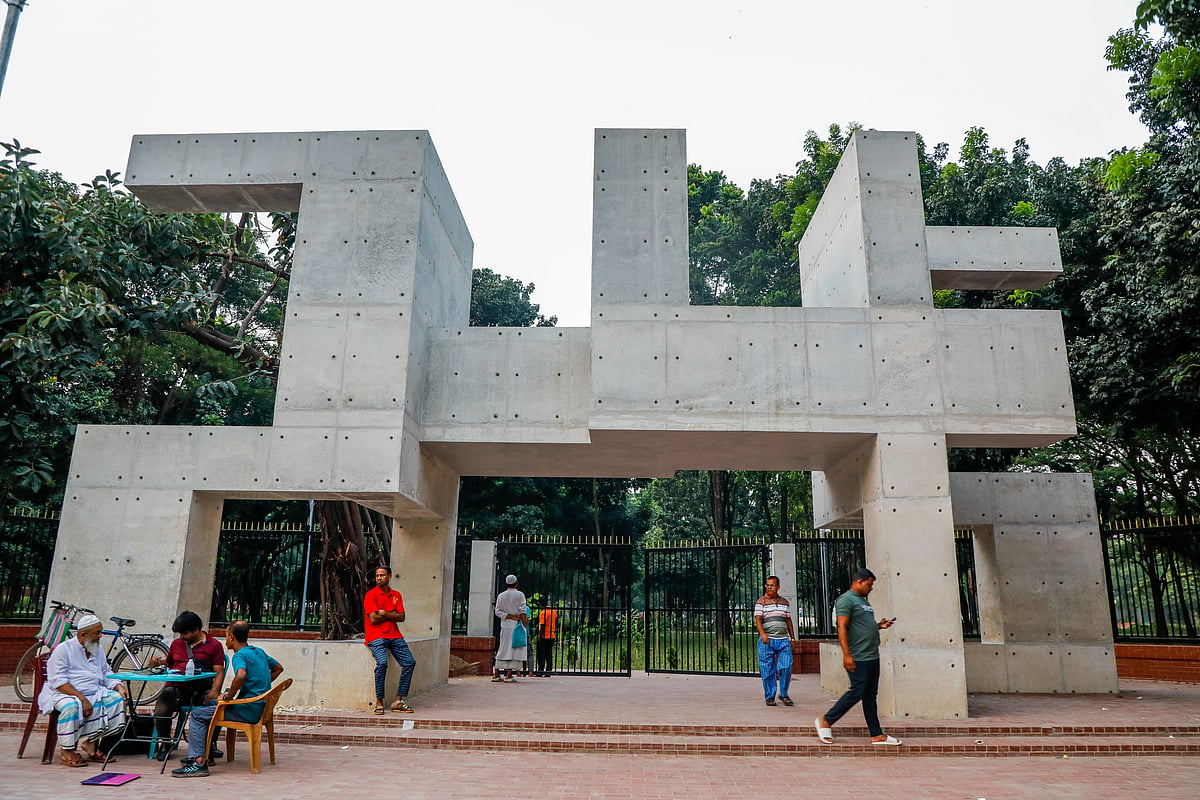
The 108-crore-taka works include a boundary wall, a city museum, a library, 12 shops, a gymnasium, car parking, lake bank development, a ghat, walking paths or walkways, and an electricity substation. The 39 crore taka built the 90-foot-high 'July Memorial' — the names of the July martyrs engraved on bronze — and two gates at the park's entrances shaped like the English numerals '24'.
Even after the inauguration, however, the museum, library, gymnasium, parking and food shops have not yet opened. Project Director Saiful Islam, who oversaw the park's renovation and development, said: 'We have handed the park over to the city corporation's estate department. Until it is leased or given to an organisation to operate, the city corporation will maintain it itself — that is the decision. The ticket arrangement at the gate has been made in line with that decision.' So the debate over the reopened 'lungs of Dhaka' now runs in two directions — relief at getting it back, and questions over the ticket fee.