Macron turns down interior minister's resignation as violence also shakes France's markets

Amid riots and violence across France, President Emmanuel Macron has rejected interior minister Laurent Nunez's offer to resign. He has kept the minister in post on the argument that continuity of leadership of the security forces is essential to handle the crisis, even though he himself has acknowledged failures.
In a statement on Monday, the French president's office, the Elysee Palace, said Nunez needed to stay to retain a chain of command within the police and security forces in the current situation. At the same time, Macron directed the interior minister to ensure transparency over the failings of the authorities concerned and to put in place new operational methods to deal with such crises more effectively.
International media reports said Macron himself mentioned failures in anticipation and intelligence behind the worsening of the crisis. Even so, he did not take the path of removing the minister.
Saturday was one of the most violent days in recent years. Around 550,000 protesters took to the streets across France that day. Although most protests were peaceful, in various cities they turned violent.
According to updated figures from the French interior ministry, 2,397 people have so far been arrested in these protests against the high cost of living and the deterioration of public services. In addition, 997 police and paramilitary personnel were injured, seven of them seriously.
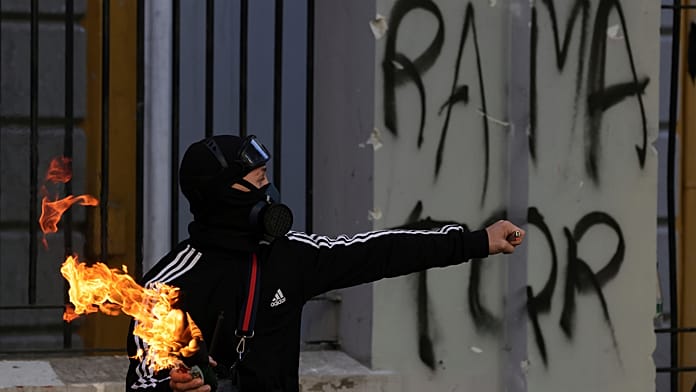
On Saturday, protests turned violent in major cities including the capital Paris, Marseille, Lyon, Bordeaux and Limoges. In Limoges, masked attackers burned down the historic town hall. Alongside attacks on municipal buildings in Marseille and Limoges, the district prefect's residence was vandalised in Bordeaux. A group of rioters reaching the vicinity of the presidential residence, the Elysee Palace, also raised big questions about the security system.
Several town halls were set on fire, and hundreds of businesses were looted or vandalised. Public discontent created by rising prices and soaring fuel costs has emerged as the cause behind these riots.
Criticism of the government over the preparation and management of the police operation has begun from many directions. Green Party presidential candidate Marine Tondelier demanded the interior minister's resignation, saying he had completely failed to grasp the scale of the crisis. France Unbowed and the National Rally also accused the government of incompetence. Former president Francois Hollande commented that the state had failed to maintain public order across the country.
Meanwhile, in a television interview on Monday, Nunez admitted that police had lost control in some cities during the protests. But denying allegations of inadequate planning, he said the security forces had had to face a well-planned group of people who had adopted the tactic of launching sudden attacks and dispersing quickly.
In a televised address to the nation on Sunday night, Macron condemned the violence as unbridled violence. He said that, looking at these images, everyone had asked themselves what was going through their minds, and how French people could do this to France.
At the same time, he spoke of distinguishing peaceful protesters from those involved in destruction. Macron also promised to remove the crisis of confidence among young people over education and future employment. With a presidential election ahead, he called for maintaining peace and unity to preserve law and order.
The shock of the violence has also hit France's financial markets. On Monday, French government debt bonds and the stock market came under a fresh wave of selling. The yield on France's 10-year bond rose by seven basis points to 4.849 percent. A rise in yields means a fall in bond prices, and this widened the gap between French and German 10-year borrowing costs.
The two-year bond yield rose by 2.5 basis points to 3.571 percent, and the 30-year bond yield rose by three basis points to 5.397 percent. Paris's CAC 40 share index fell by 1 percent at the start of the day. The euro also slipped slightly against the dollar, to 1.122 dollars.
Jim Reid of Deutsche Bank said the protests would not make it easy for international investors to feel comfortable buying French government bonds. In his view, with France's difficult fiscal backdrop and the 2027 election approaching, the weekend has added another layer of political risk.
Rising borrowing costs will add further strain to France's public finances. The government is trying to pass a budget for next year to rein in its deficit, with plans to cut pensions spending and funding for government departments, excluding defence. But fears are also growing that political pressure could derail those plans.
Meanwhile, Macron began a four-day Gulf tour on Monday to bring down fuel prices and secure new agreements for oil and diesel supplies. From 19 to 21 October he will visit Kuwait, the United Arab Emirates, Bahrain and Qatar. Reports said a fuel crisis has been created in France as oil supplies from the Gulf region have been severely disrupted by geopolitical crises in the Strait of Hormuz and the Bab al-Mandeb.