
America Astir with Anti-Trump 'No Kings' Events, Eyes Now on Early Voting
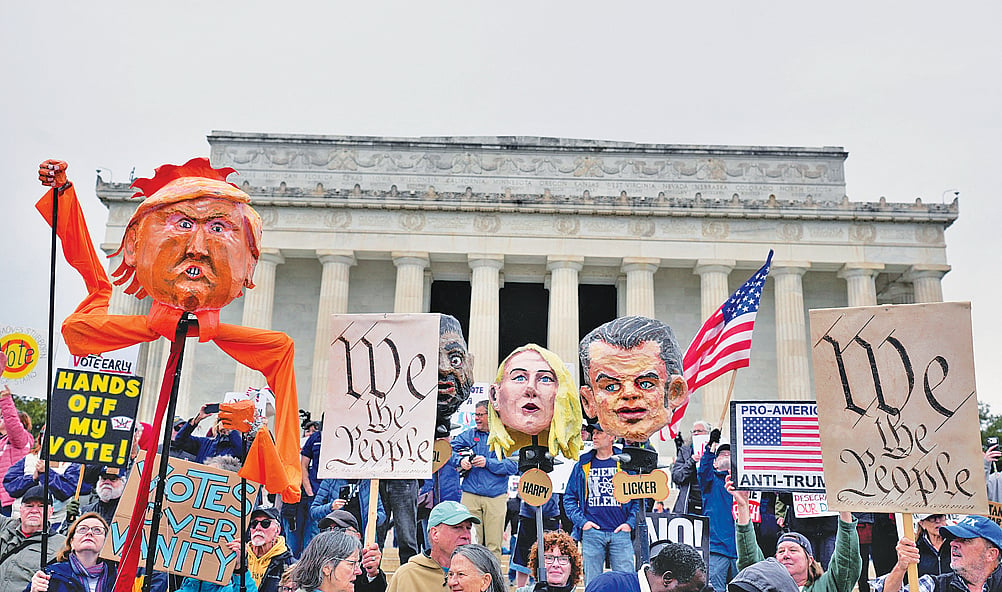
Protests have taken place across the country once again against US President Donald Trump. 'No Kings' — meaning 'we have no king' — protesters expressed their anger against Trump last Saturday through nearly three thousand events across the United States. But the character of this round of events was different from before: instead of big rallies, the organisers put emphasis on reaching voters through small events.
The main target of this round of events was the vote. The organisers made encouraging people to cast early votes in the midterm elections on 3 November their principal objective. In other words, this time they wanted to convert street protests directly into polling-station-focused activity.
This programme came at a time when, because of the Iran war, the price of fuel and the cost of living have risen in the United States. At the same time, President Trump's popularity is also falling by a record amount. For these reasons, it is being thought that Trump's party, the Republican Party, could lose its majority in Congress in the coming midterm elections — and that calculation has made the protesters' strategy this time even more significant.
On Saturday, 'No Kings' protesters took to the streets in many big and small cities, from Washington to New York and Los Angeles. In some places the programme was observed with convoys of cars sounding horns, in others through musical performances, and in others through gatherings. Although the form of the programme varied from city to city, the message was the same — opposition to Trump's style of rule.
This is the fourth time a 'No Kings' programme has been held since Trump returned to power for a second term. The movement began after Trump took power for a second term in January last year. According to the protesters, Trump wants to establish himself above the law, or like a king, which is contrary to the US Constitution — the very name of the movement expresses that position.
However, the organisers did not want to limit this round of events to expressing anger alone. They tried to make voters aware of registration and of the methods of voting. Especially in the areas where early voting has already started, increasing participation there was their priority.
Near the Capitol building in Washington, retired teacher Sabin Carlson stood holding an umbrella. Written on her umbrella was — 'Vote, power, people'. The 66-year-old Democrat said venting anger is good, and complaints are many; but the most urgent task is to vote.
According to Carlson, voters need to know where and how to vote, and whether their registration is correct. Awareness is also needed so that no one falls into trouble by going to the wrong polling centre. Through her remarks, it can be understood that this time the mood of the movement has leaned towards practical preparation alongside protest.
In most areas of the United States, the opportunity to vote exists from several weeks before the designated election day. The organisers of the 'No Kings' movement want to make use of that very opportunity — ensuring votes early, avoiding the crowd and uncertainty of election day, is at the centre of their plan.
Alma Cuvarthi, a grassroots organiser of 'Common Cause', an organisation working on voting rights, said: 'Our goal is for people to see voting as an act of exercising power, fulfilling duty and joy.' Her remarks make clear the picture of the movement's transformation this time — a journey from protest towards participation.
In contrast, President Trump himself has been criticising the mail-in voting system. On the other hand, the movement's organisers fear that if the Republicans are defeated in the election, there could be an attempt to question the result or obstruct it. It is understood that this fear is why they are giving so much importance to early voting.
All in all, Saturday's nearly three thousand events have shown that the anti-Trump movement is now moving from street slogans towards the arithmetic of votes. The rate of early voting in the weeks before the midterm elections will tell how much this strategy has worked — and whether it will have an impact on the fight for a majority in Congress is now the big question of American politics.