French Government in Crisis Meeting Amid Violent Unrest Across the Country; Town Hall Burned, More Than 2,000 Arrested
After one of the most violent days of the year, the French government sat in a crisis meeting on Sunday. With government buildings set on fire in various cities across the country, hundreds of shops destroyed and looted, and more than two thousand people arrested, intense pressure has built up over the role of ministers, officials and police.
Politicians from both the left and the right have demanded the resignation of Interior Minister Laurent Nuñez. Their allegation is that the government was effectively caught unprepared by the scale of the violence — attacks and arson on government buildings, vandalism of bus stops, barricades on roads, and the smashing and destruction of shops.
President Emmanuel Macron, who is set to leave office next spring, was preparing to address the nation on Sunday night. He wrote on social media that there is no place for violence in France.
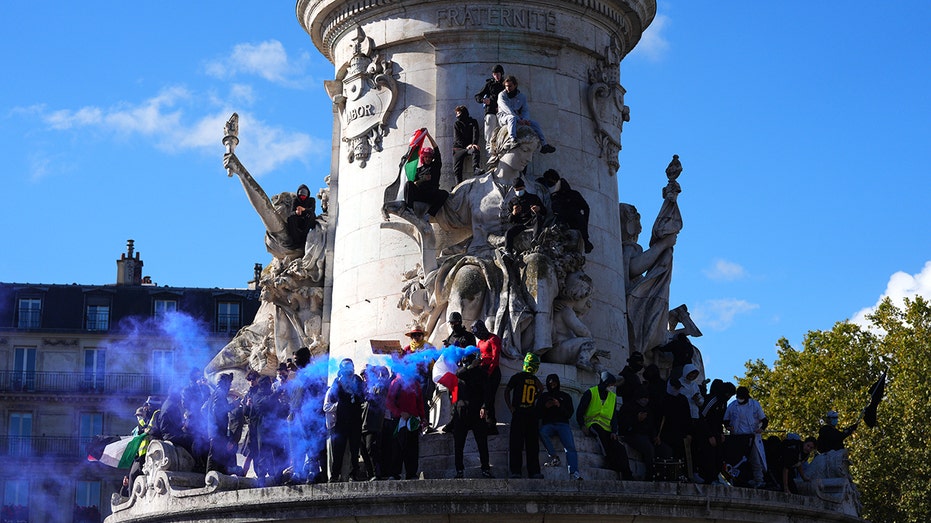
On Saturday, police and officials had to face different kinds of challenges at the same time. First, thousands of people took part in peaceful marches in big cities including Paris. In support of school students' demands for more teachers and repairs to dilapidated schools, these marches were joined, alongside students, by parents, teachers, elderly citizens and protesters over the cost of living. The program followed four weeks of street marches and school barricades.
But alongside the peaceful protests, different groups caught police and officials unprepared. In Paris, Bordeaux, Nice, Marseille and other cities there were ongoing gatherings, scattered arson, road barricades and clashes with police.
Taking advantage of this, masked looters smashed shopfronts and carried away goods, which French media described as 'chaos.' In Paris, after masked adults smashed shops, groups of looters including some children were seen running through the night streets with boxes of clothes and shoes.
According to Paris police, a record 855 people were arrested. On Sunday, several streets in the capital were littered with the burned remains of barricades made from bicycles, bins and other materials, broken shop windows and the remains of burned cars. Paris's Socialist deputy mayor Lamia El Aaraje said the capital saw a scale of violence that, she believes, it had never seen before.
In Limoges in central France, the nineteenth-century town hall was burned down. The city's mayor, Guillaume Guérin, said those who attacked the building and set it on fire are not protesters for any demand, but people 'organized for war.' According to him, the attackers threatened to kill a caretaker of the building and spoke of burning the elected representatives.
Guérin also said that although municipal police were present in numbers around 3:30 in the afternoon, having run out of ammunition they could not continue the fight against the rioters' violence. He described this situation as 'a massive failure of the state' — the phrase that set the tone of the entire crisis.
In Marseille, masked groups attacked the city hall and a police station. The city's Socialist mayor, Benoît Payan, told a television channel that he had no words and had never imagined he would see such a thing. In his words, groups of rioters and looters, without any real demand, attacked joint state buildings with the sole purpose of destroying the demands of those protesting legitimately. He raised questions about police strategy as town halls in other cities, such as Lille, were also targeted.
Lyon's Green mayor Grégory Doucet said he had never before seen such violence in his city, including arson at the historic tourism office. He said that in the violence against state property he saw and heard shock, fear and anger, and shopkeepers felt abandoned. He commented that the government must find a 'sense of nuance' — on the one hand giving a political response to the peaceful protesters' longstanding social demands, and on the other seeking the roots of the violence.
Business organizations said more than 1,500 shops and businesses were subjected to looting and the damage reached several tens of millions of euros. The owner of a shoe shop in Paris said this has nothing to do with the peaceful protesters; these were organized groups who were smashing and looting — something never seen before.
According to the Interior Ministry, alongside the more than 2,000 arrests, about 600 police, firefighters and paramedics were injured. In the southern city of Saint-Étienne, a crowd-control grenade blew off the right hand of a 17-year-old boy. Opposition politicians raised questions about the government's police strategy and deficiencies in state intelligence.
Macron's centrist government and Marine Le Pen, the far-right frontrunner in the presidential election, both blamed so-called 'ultra-left' groups for the violence. Prime Minister Sébastien Lecornu said the government will not be frightened by violence and blamed the 'ultra-left' and criminals for the unrest. On the other hand, far-left presidential candidate Jean-Luc Mélenchon, who took part in Saturday's peaceful march in Paris, alleged that the government's organizational failure 'opened the door to chaos.' Lecornu replied on social media that placing the blame for the violence on police chiefs is a dangerous and hypocritical reversal of responsibility. All eyes are now on Macron's speech on Sunday night.