Rare ring found in Cleopatra's sunken palace, bears a picture of one of the ancient world's seven wonders
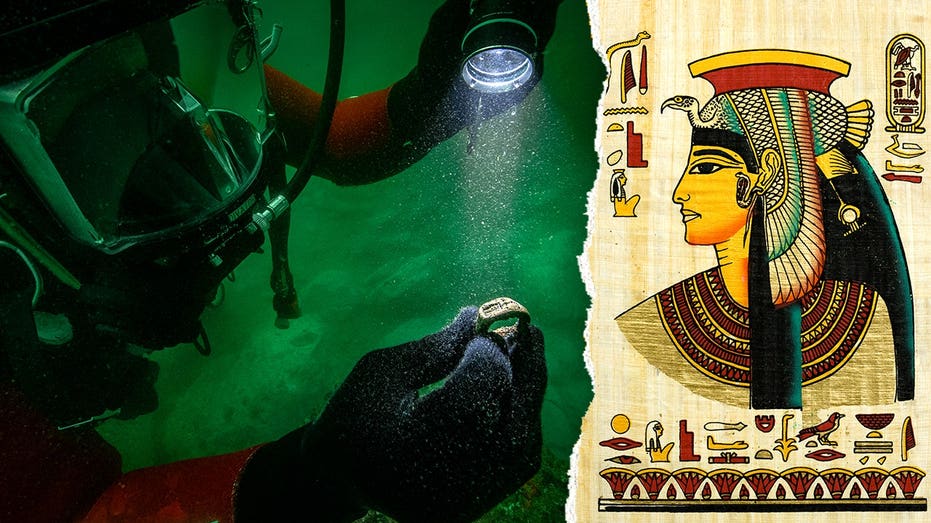
An ancient bronze ring has been found in the sunken royal harbour of Alexandria, Egypt, on which is engraved a picture of the Lighthouse of Alexandria — one of the Seven Wonders of the Ancient World. Archaeologists have recently announced this discovery in the area of the sunken palace associated with Cleopatra.
The discovery was made in Alexandria's sunken royal harbour and was announced this month by the European Institute for Underwater Archaeology. The ring was found at the site of a royal palace on the sunken island of Antirhodos.
Antirhodos was part of Alexandria's ancient royal area, with which the names of Cleopatra VII, Mark Antony and Julius Caesar are associated. Researchers say that because the ring was found on the very soil of that centre of power, its importance has increased further.
Officials said the bronze ring bears a picture of the Lighthouse of Alexandria. Among signet rings used in the work of sealing, this is the first known example that bears a picture of this famous structure.
The lighthouse was built in the third century BC. For century after century it showed the way to ships, and later, being destroyed by earthquakes over several centuries, its final fall occurred around the fourteenth century, the report said.
The ring's age is still not clear. However, the publication of 7 October said the style of its picture matches the pictures found on some second-century coins. In the published pictures, a small, weather-worn ring can be seen, with a faint carving of the lighthouse on its golden-coloured surface.
Franck Goddio, president of the European Institute for Underwater Archaeology and leader of the excavation team, emphasized the importance of where the ring was found. He said in a press release that the discovery of the ring-signet is more important because it was excavated at the legendary palace of Antirhodos island, which was once a centre of power.
Alexandra F. Morris, a lecturer in ancient history at Queen's University Belfast, described the work of underwater excavation as extremely careful. In her words, everything has to be found by the divers themselves, documented and brought up.
According to Morris, the palace that Cleopatra may once have used may later have been used as an administrative office, and possibly was connected with overseeing the operations of the Lighthouse of Alexandria. She thinks the ring's picture may represent that very administrative connection.
However, Morris cautioned that the ring's age is still unknown — it could be of either the Ptolemaic or the Roman era. Even so, she mentioned, the artefact highlights the importance of the lighthouse to the ancient city.
In her words, the lighthouse has now become small and sat on someone's finger, and was used in the work of sealing official documents. It essentially shows that, long after being built, the lighthouse had turned into a symbol of Alexandria.
Beyond historical importance, Morris also thinks the ring can help bring Alexandria's underwater history to ordinary people more easily. As the city is underwater, reaching there is difficult; replicas or models of objects like the ring people will be able to hold in their hands and see.
As a museum professional, Morris described the ring as a 'perfect object' for touch-based exhibitions, which could also be useful for those interested in the site, including blind and low-vision visitors. Attention will now be on what further research gives about this rare artefact.